
Beyond Strategy: Why Brilliant Corporate Leaders Fail at Executive Execution
Every year, organizations in Singapore invest millions of dollars into high-level corporate strategies, market forecasting, and sophisticated business software. Executive teams spend weeks inside boardroom retreats carving out flawless five-year roadmaps to capture new market segments.
Yet, when these strategies are rolled out into the market, a staggering percentage of them completely stall during execution.
Milestones are missed. Critical projects stall in a loop of endless review. Senior managers experience sudden decision paralysis when faced with fast-moving market shifts. When execution fails, boards often blame market volatility, poor team alignment, or a lack of individual accountability.
However, advanced organisational neuroscience reveals a deeper, structural bottleneck. The failure of strategic execution is rarely a failure of planning. Rather, it is a direct consequence of a metacognitive deficit in executive functioning.
Organisations must move beyond traditional skill-building workshops. Leadership development must target Intrapersonal Cognitive Theory of Mind (ToM), the clinical framework for metacognition.

The Reality of Executive Paralysis and Strategic Stalling
In Singapore’s fast-paced corporate ecosystem, a leader’s worth is defined by their ability to navigate ambiguity and drive swift execution. However, as professionals rise into senior management, the nature of their responsibilities shifts. They move from concrete, linear tasks to highly abstract, multi-variable decisions. This sudden increase in abstraction can trigger an internal crisis known as execution paralysis. And it can happen for any brain navigating executive functioning difficulties or unmanaged adult ADHD.
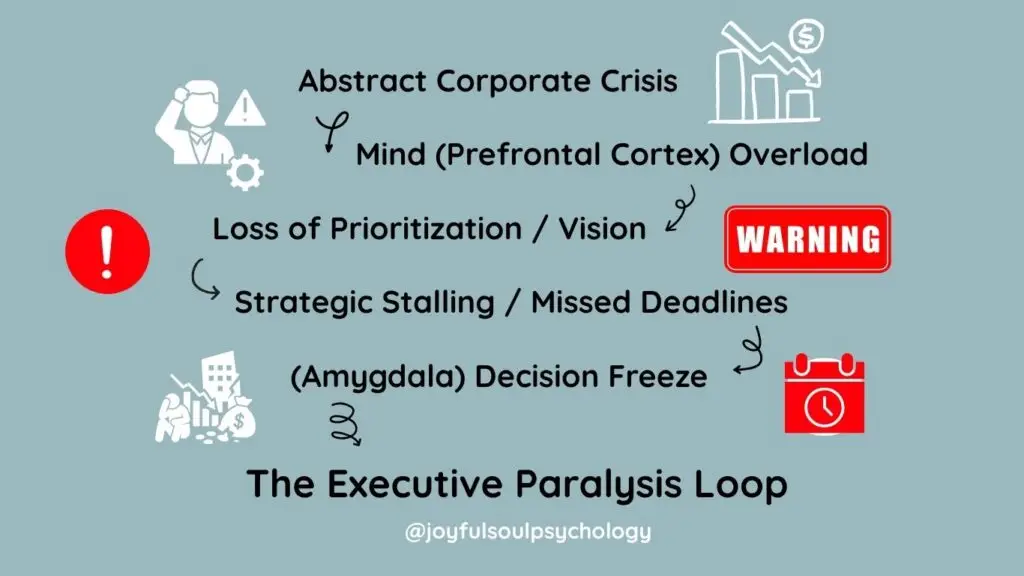
Managing a corporate restructuring or launching an unproven product line are complex, high-stakes decisions. A leader’s brain can become overwhelmed by data data. This is not a lack of business intelligence or strategic vision. Instead, the mind (prefrontal cortex) becomes overloaded. It is clouding the ability to prioritise tasks, map out clear execution steps, and manage working memory under stress. The leader finds themselves trapped in a state of hyper-focus on minor details while delaying major, high-impact decisions. They may request endless data revisions or hold redundant alignment meetings just to delay execution.
This internal freeze quickly ripples across the entire organization, stalling team momentum and creating a culture of cautious task avoidance.
Metacognition and the Prefrontal Executive Network
To unlock a corporate team’s true execution power, leadership development programs must address the cognitive science behind decision-making. Intrapersonal Cognitive Theory of Mind is the clinical term for metacognition. It is the specialised capability to step back, monitor, evaluate, and consciously regulate your own internal thinking and problem-solving processes.
Metacognition is the master conductor of the brain’s executive functioning network, which is managed by the prefrontal cortex. It allows a leader to evaluate their own cognitive performance in real time. For example, “My team is freezing because my current directive is too ambiguous. I need to step back, clarify our three immediate metrics, and adjust my communication strategy.”
When a leader lacks strong metacognitive coaching, their ability to self-correct during a crisis collapses. Under intense corporate pressure, their brain experiences a drop in dopamine saliency. Hence, shifting their focus from long-term strategic growth to immediate threat mitigation. They fall into a fixed mindset loop. Thus, viewing a missed quarterly target or a project failure as an immediate threat to their authority. Instead of a data point for strategic adjustment. And to protect their professional standing, they double down on rigid, outdated processes, micro-manage their teams, and reject innovative ideas.
Traditional leadership training that relies on lecturing or theoretical case studies cannot repair this structural prefrontal overload. True change requires building deep metacognitive resilience.
Leadership Checklist: Identifying Metacognitive Bottlenecks in Your Executive Team
To determine whether one is experiencing an authentic metacognitive deficit (rather than a lack of business capability), evaluate your operational patterns against this checklist:
- Defensive Resistance to Feedback: Reacting to standard operational critique or performance data with immediate personal defensiveness, blame-shifting, or a refusal to alter current methods.
- Chronic Stalling in the “Analysis Paralysis” Stage: Consistently delaying the launch of critical projects by requesting redundant data reviews, extra reports, or repetitive alignment meetings.
- Rigid Micro-Management of Trivial Tasks: A senior executive who spends hours controlling low-impact team outputs (like slide deck fonts or email phrasing) while delaying major strategic choices.
- Inability to Pivot During Market Shifts: Responding to unexpected market disruptions or project failures by doubling down on rigid processes, rather than displaying agile problem-solving.
- Poor Cognitive Time-Estimation (Time Blindness): Routinely over-promising aggressive deliverable timelines to clients or boards, followed by a total internal rush and project delays due to poor resource planning.

with metacognitive skill development
Strategic Solutions: Cultivating a High-Execution Corporate Culture
Overcoming executive paralysis and strategic stalling requires shifting your leadership training from theoretical business theory to structural, metacognitive skill development.
By integrating neurocognitive strategies into your executive suite, your organization can build lasting execution agility:
1. Externalise Executive Workflows with Visual Architecture
Do not force your management team to hold complex, multi-variable project maps entirely in their heads. This overloads working memory and triggers decision freeze. Require your leadership to externalize their cognitive workflows using clear visual tools. For example, dynamic digital roadmaps, structured logic trees, and visible progress walls. Moving plan details onto a physical or digital medium. It frees up prefrontal cortex capacity, allowing leaders to focus on high-level analysis and swift decision initiation.
2. Implement the “High-Probability Request Sequence” for Complex Tasks
When your organization faces a massive, high-risk objective, break the execution freeze by applying the behavioral principle of behavioral momentum. Train your managers to structure their rollout using a sequence of small, high-success, low-friction micro-steps before introducing high-risk milestones. Securing a few quick, predictable early wins triggers a positive dopamine feedback loop in the team’s brain. It is building the confidence and momentum needed to execute complex components without performance panic.
3. Shift from Outcome Blame to Metacognitive Debriefs
Transform your post-project reviews from punitive finger-pointing sessions into structured growth exercises. Train leadership to run post-mortem evaluations that focus on the cognitive process: What assumptions did we make? How did we monitor our progress? When did we realize our strategy needed adjustment? Normalizing the analysis of thinking patterns helps executives transition away from a defensive fixed mindset. It is embedding an agile, continuous-learning approach across your corporate culture.
The Executive Next Step: Upgrade Your Leadership Capabilities
Brilliant corporate strategy is useless without the structural cognitive capacity to execute it. True leadership excellence is not an unchangeable personality trait. It is a system of executive functioning skills and metacognitive habits that can be intentionally built, measured, and optimized.
At Joyful Soul Psychology, we specialise in transforming high-potential executives into high-performing leaders. Our tailored corporate services move past traditional coaching platitudes to deliver neuroscience-driven sessions.
Our strategic conversations drive high-stakes business execution through six core pillars:
- Specialised Executive Functioning Training: Mastering the focus, planning, and execution required in high-stress environments.
- Vision Alignment: Synchronizing team direction and corporate strategy.
- Leadership Sounding Boards: Private, high-level counsel for executive decision-making.
- Executive Performance Workshops: Immersive sessions built to accelerate business output.
- Advanced Metacognitive Development: Upgrading cognitive agility and self-awareness for complex leadership.
- Strategic Communication Agility: Expanding leadership awareness to navigate high-friction dynamics, align diverse stakeholders, and command influence.
Unblock your executive pipeline and accelerate your strategic execution. Schedule a confidential strategic conversation today and build a high-performance leadership team.
What’sApp +65 8835 3015 / Email contact@joyfulsoulpsychology.com / IG https://www.instagram.com/joyfulsoulpsychology/ / JSP Supports https://joyfulsoulpsychology.com/services/

