
The Collaboration Bottleneck: Resolving the Hidden Communication Gaps in Cross-Functional Teams
In today’s matrixed corporate and educational organizations in Singapore, business goals are rarely accomplished in isolation. Achieving success requires seamless, rapid cross-functional collaboration. A single corporate initiative or educational project requires software engineers, marketing specialists, compliance officers, and finance directors to coordinate their efforts perfectly across multiple shared communication channels.
Yet, this interconnected setup is exactly where many high-potential projects run into severe delays.
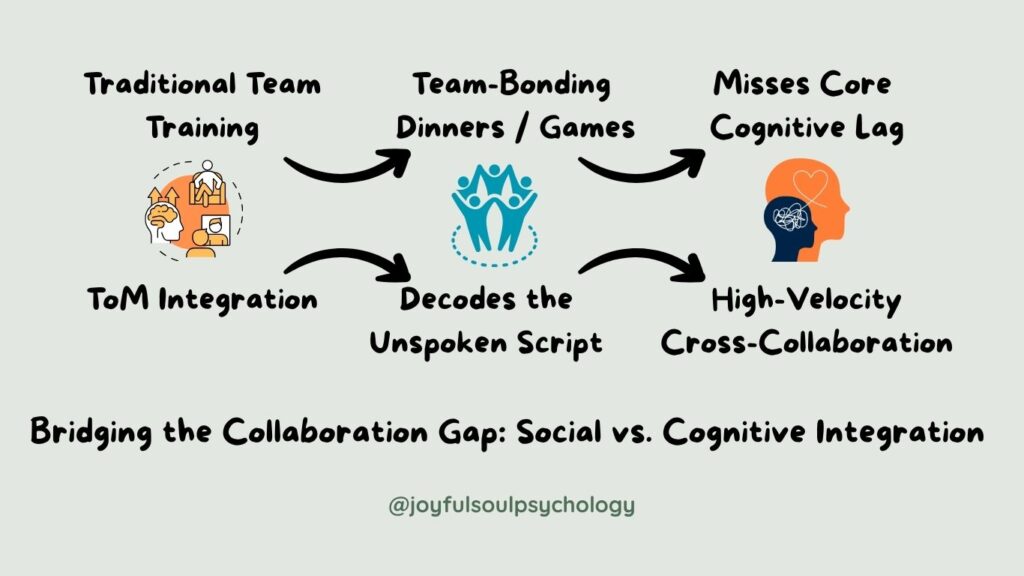
Departments misunderstand each other’s priorities, email exchanges lapse into passive-aggressive debates, and teams operate in isolated silos. When collaboration breaks down, management usually attempts to fix the issue by holding team-building days, reorganizing reporting structures, or mandating more alignment meetings.
However, these surface fixes fail because they do not address the true root cause. Workplace friction is rarely a failure of goodwill. It is a direct result of a higher-order social communication divergence within teams.
To turn a group of isolated departments into a genuinely unified, high-performing team, organizations must invest in advanced social communication training. Teams must learn to decode the unwritten rules of professional interaction by unlocking Interpersonal Affective and Cognitive Theory of Mind (ToM)..
The Reality of Professional Misalignment and Social Cue Overload
In a fast-paced Singaporean workplace, communication is rarely limited to literal words. Every single day, employees are expected to read between the lines of subtle office diplomacy. They must decipher the unwritten expectations behind an indirect email request, decode the shifting group dynamics during a tense Microsoft Teams call, and read the unspoken boundaries of cross-functional stakeholders.
For a significant portion of workforce, this constant need to decode subtext creates immense cognitive strain, leading to social cue fatigue. This challenge is faced by most regardless if you are an neurodivergent professionals or individuals experiencing high interaction anxiety,
Instead of focusing on task execution, employees spend valuable mental energy guessing at the hidden motives of colleagues in other departments. When an individual struggles to read these unwritten professional rules accurately, misalignment quickly follows. A technical team might take a marketing department’s open-ended feedback too literally, leading to costly development errors. Alternatively, a team member might misinterpret a colleague’s direct, concise message as a personal attack, triggering a defensive cycle of finger-pointing.
This hidden social friction quietly stalls project momentum, lowers employee engagement, and builds a culture of workplace anxiety.

Deep Social Tracking and Higher-Order ToM
To build a truly collaborative corporate culture, leadership development must explore the neurobiology of interpersonal communication. Interpersonal Affective Theory of Mind is the cognitive system that allows us to accurately infer, decode, and track what other people are experiencing emotionally in real time. Its counterpart, Higher-Order Cognitive ToM, allows us to process complex, nested perspectives: “What does my regional director think that our client expects us to deliver based on this feedback?”
In a professional setting, this system acts as a real-time cognitive translator. It enables a project manager to look at a stakeholder’s subtle shift in body language or hear a slight change in their vocal pitch during a negotiation. Then immediately draw a logical conclusion: “They are expressing surface compliance, but they feel their department’s budget is being threatened. I need to reframe my proposal to protect their interests.”
Neurobiological studies show that this advanced mentalising capacity relies on strong connectivity between the temporal parietal juncture (TPJ) and the dorsal medial prefrontal cortex (dmPFC). These regions act as the brain’s social processing hub, mapping out the unwritten rules of human interaction.
When a processing divergence or cognitive lag occurs in this network, reading the workplace landscape becomes an exhausting, manual calculation. The individual cannot intuitively feel the social dynamics of a meeting. They must try to solve the social equation using pure logic.
Under heavy workload stress, this manual processing often slips up. The individual may miss subtle social boundaries, struggle with conversational turn-taking during fast-paced debates, take constructive criticism too literally, or fail to tailor their message to the specific needs of different departments.
Traditional team-building exercises like corporate dinners or recreational games cannot bridge this structural processing gap. High-performance collaboration requires explicit training in the unspoken scripts of corporate communication.
Collaboration Checklist: Spotting Communication Friction in Matrix Teams
If you are an operations director, HR leader, or department head trying to identify hidden communication gaps and social cue fatigue within your cross-functional teams, monitor your projects for these clear warning signs:
- Silo Maintenance and Information Hoarding: Departments that consistently refuse to share raw data, updates, or project contexts unless explicitly forced to do so by a senior executive.
- The Rise of Passive-Aggressive Loops: A rising pattern of tense email chains filled with defensive phrasing, copied managers, and defensive posturing over minor details.
- Literalism Resulting in Project Misalignment: Teams executing tasks exactly to the literal letter of an early brief, while completely ignoring obvious contextual shifts or unwritten client expectations.
- Extreme Meeting Fatigue and Post-Call Panic: Team members who appear quiet and compliant during live cross-functional calls, but immediately follow up with intense, anxious private messages over-analyzing what was said.
- Avoidance of Direct Conflict Resolution: Choosing to escalate minor interpersonal differences to senior leadership or HR, rather than utilizing direct, constructive conversation to resolve the issue.
Strategic Solutions: Engineering High-Velocity Corporate Collaboration
Resolving communication difficulties and unlocking collaborative performance requires shifting your learning and development strategy from superficial team-building events to structural social communication frameworks. By embedding these neurocognitive principles into your organization, you can turn cross-functional friction into a competitive advantage:
1. Implement Explicit, Standardized Communication Protocols
Do not force your teams to guess the hidden intentions or unspoken boundaries behind daily updates. Establish clear, company-wide communication guidelines that remove ambiguity from digital collaboration. Require that all cross-functional updates follow a standardized, factual format. Example, clearly stating the Objective Context, the Exact Action Required, the Responsible Owner, and the Firm Deadline. Removing the need to decode subtext eliminates anxiety and allows teams to coordinate their efforts efficiently.
2. Deploy Functional Communication Mapping for Stakeholders
Train your cross-functional project leads to approach stakeholder management like a systematic mapping exercise. Before launching a major initiative, require teams to document the unique perspective, underlying priorities, and potential operational fears of every department involved. Mapping out these diverse institutional perspectives helps project leads tailor their communication style to match the exact needs of each audience, preventing misunderstandings before they start.
3. Establish a Standardized “Safety-First” Verification Script
Normalize the practice of direct, casual verification during high-stakes cross-functional collaborations to clear up social ambiguity. Encourage team members to use explicit, non-defensive check-in phrases. Example: “To make sure our teams are aligned, let me summarise what I understand your department needs from us.” Integrating this simple verification script into daily workflows removes the guesswork from collaboration and prevents miscommunication from derailing your projects.
The Executive Next Step: Drive High-Performance Collaboration
Smooth corporate collaboration is not a random result of hiring compatible personalities. It is a direct consequence of building clear, explicit communication structures. It is also giving your team the cognitive tools to read their environment accurately. True team alignment happens when you replace unwritten social guessing games with logical communication frameworks.
At Joyful Soul Psychology, we specialize in resolving the deep, structural communication difficulties that stall corporate and educational organizations. Our evidence-based solutions move beyond generic team-building events to deliver neuroscience-driven communication strategies. We provide advanced social communication training, customised cross-functional collaboration workshops, and specialised workplace conflict resolution consulting built for elite organisational performance.
Eliminate communication friction and unlock your team’s true collaborative power. Contact us today to co-create an integrated training roadmap for your organization.
What’sApp +65 8835 3015 / Email contact@joyfulsoulpsychology.com / IG https://www.instagram.com/joyfulsoulpsychology/ / JSP Supports https://joyfulsoulpsychology.com/services/

