
Trapped by Perfection? How the Stickler Saboteur Hijacks Our Performance and Peace
Executive Summary
- The Problem: Many high-achieving professionals face chronic stress, exhaustion, and frustration due to an extreme, rigid need for flawless execution and order.
- The Subconscious Blueprint: This pattern is driven by the Stickler Saboteur (inner critic), an internal guardian formed in childhood that has evolved into an invisible mental barrier.
- The Solution: Shifting into a calm, clear-headed Sage Mindset requires building mental fitness to intercept perfectionist lies and protect our performance.
As high-functioning professionals, leaders, and creators, we pride ourselves on exceptional execution. We push for excellence, cross every ‘t’, and dot every ‘i’. But for many of us, there is a point where healthy high standards quietly cross the line into toxic, rigid perfectionism.
When we find ourself continuously anxious about minor mistakes, constantly frustrated that others don’t meet our structural expectations, or holding our hand on a metaphorical hot stove of stress, we are likely being hijacked.
In the Positive Intelligence (PQ) framework, this internal voice isn’t “excellence”, it is the Stickler Saboteur, and it is systematically robbing us of our peace, performance, and relationships.

The Lie of High Standards: Anatomy of the Stickler Saboteur
The Stickler is a classic accomplice to our universal Master Saboteur: The Judge. To justify its constant badgering and anxiety-inducing behaviour, the Stickler whispers a convincing lie: “If I don’t push for total perfection, everything will descend into chaos and I will fail.”
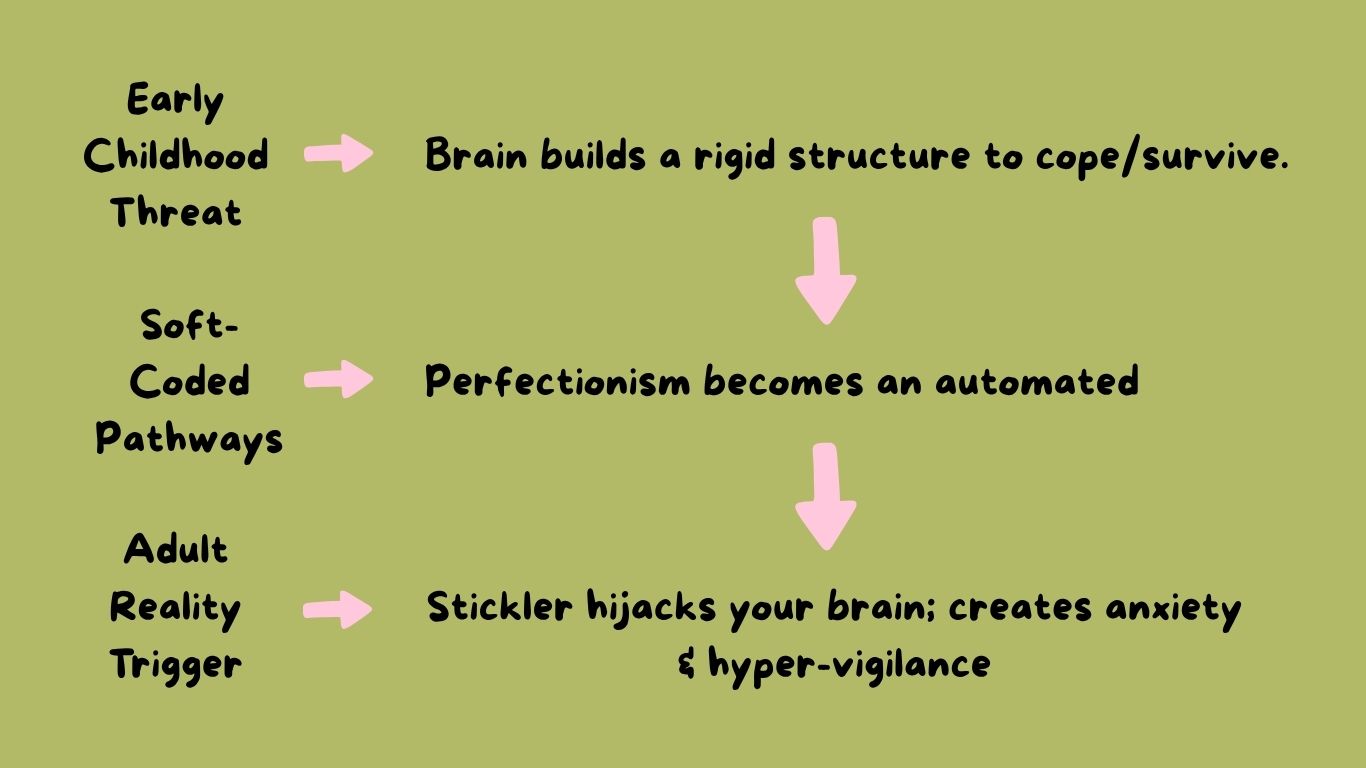
Like all Saboteurs, the Stickler originated as a mental guardian during our early developmental years to help us find emotional or physical safety. If our environment felt unpredictable, chaotic, or highly critical, our brain soft-coded a protective coping mechanism: absolute control over order, correctness, and organization.
By adulthood, we no longer need this shield to survive, but the neural pathway remains highly automated. The moment pressure mounts in our career or personal life, the Stickler takes the wheel, leaving us trapped in obsessive, anxious loops.
The Cost of the Shield: Chronic Stress and Strained Relationships
While negative emotions like anxiety, frustration, or fear are helpful for a single second to alert us to an actual danger, staying in a Stickler loop for minutes, hours, or days limits our perspective. Chronic perfectionism inflicts a severe operational tax on our life:
- Tunnel-Visioned Decision Making: When our brain is hyper-focused on everything that is “imperfect,” our nervous system enters a fight-or-flight response. We cannot access our positive brain’s capacity for creative, calm, and strategic problem-solving.
- Sustained Emotional Fatigue: The Stickler discounts our latest achievements almost immediately. The moment us finish a major project, instead of celebrating, our mind shifts to what could have been better, leaving us running on an endless treadmill of needing to do “more” to feel validated.
- Friction in Teams and Relationships: The intense impatience and anxiety we feel when things aren’t perfectly organised can project outwards as intellectual arrogance or harsh judgment. This behaviour drives deep resentment in coworkers, employees, and loved ones.
THE PQ HOT STOVE RULE: Negative emotions are only helpful for a quick second to tell us to take our hand off a hot burner. When we stay stressed, frustrated, or unhappy, our Saboteur is holding our hand on the stove while complaining that life is hard.
The 3-Step Mental Fitness Intervention: Conquering the Stickler
To break free from the grip of rigid perfectionism, we must actively build new neural pathways using three core mental fitness muscles:
1. Intercept the Saboteur Mode
The moment we feel anxiety, frustration, or a compulsive need to micromanage a situation surfacing, pause. Label the internal narrative: “That is my Stickler talking, not reality.” By calling out its limiting beliefs and discrediting its lies, we create cognitive distance and take away its power over our immediate behaviour.
2. Exercise Our Self-Command Muscle
Quiet the overactive, stressed region of our brain by running brief, 10-second sensory micro-reps (PQ Reps). Rub two fingertips together with such exquisite attention that we feel the tiny ridges on both pads. Alternatively, close our eyes and focus entirely on the physical weight of our feet flat on the floor. This shifts our brain’s locus of control out of stress reactions and activates our calm neural networks.
3. Activate Our Sage Powers
Once our nervous system is regulated, look at the challenge through our Sage Mindset, the part of us capable of handling obstacles with absolute clarity, curiosity, and positive emotions. Ask ourself: “How can I approach this situation with adaptive flexibility, and what is the gift or opportunity hidden within this imperfection?”
Decode Your Mind: Your Journey to Sustainable High Performance
Conquering an internal adversary requires first making it visible. We cannot dismantle a pattern that you mistake for your own personality or core values.
Your first step toward reclaiming your executive focus and emotional freedom is exposing the hidden scripts running in our subconscious mind.
- Step 1: Uncover Your Personal Mental Blocks: Take the official, science-backed Positive Intelligence Saboteur Assessment to receive an immediate, personalised breakdown of your top mental saboteurs.
- Step 2: Build Lasting Positive Habits: Once you have your results, take ownership of your mental fitness blueprint and email them to jsp.wyeo@gmail.com. We decode your customised report, unmask your inner critics, and you acquire the practical tools needed to step into sustainable, adult-led performance.
* blog content inspired and adapted by post from Shirzad’s Positive Intelligence. The Stickler image is from PQ.

