
“Did I Say Something Wrong?” — Decoding the Exhausting Landscape of Social Cue Fatigue
Parents and caregivers in Singapore often watch their adolescents and young adults gradually withdraw from social circles, choosing to spend their weekends isolated in their rooms. When asked why they avoid gatherings, group outings, or school orientation camps, the answer is rarely a complete lack of interest in making friends. Instead, it stems from a deep, systemic exhaustion.
If you are the young adult navigating this reality, you know this exhaustion intimately. You walk away from every group hangout, university project meeting, or casual lunch feeling a heavy weight of anxiety. You find yourself over-analysing every single conversation, wondering if your tone of voice was off, worrying that you spoke too fast, or stressing that you inadvertently crossed an unspoken boundary.
Trying to decipher what people actually mean, rather than just what they are literally saying, takes an immense toll on your mental wellness. This persistent social exhaustion is not just introversion or simple shyness; it is a clinical phenomenon known as social cue fatigue, driven by underlying communication difficulties. To bridge this social gap without burning out, we must explore a vital neurological mechanism: Interpersonal Affective Theory of Mind (ToM).

The Reality of Social Performance and Cognitive Exhaustion
In Singapore’s highly collaborative educational and professional environments, social interactions are rarely straightforward. Whether navigating group assignments in a polytechnic class, adjusting to a new junior college clique, or participating in corporate networking sessions, individuals are constantly expected to read between the lines.
To a neurotypical mind, processing these unspoken rules happens instinctively. But for a neurodivergent brain — particularly one wired with ADHD, Autism, or high social anxiety — there is no automated script. Every single social interaction becomes an intense, manual decoding task.
When we miss these subtle cues and push for immediate conversation, we inadvertently cause a relational “mismatch”. We are bringing a high-energy communication demand into a low-capacity processing space.
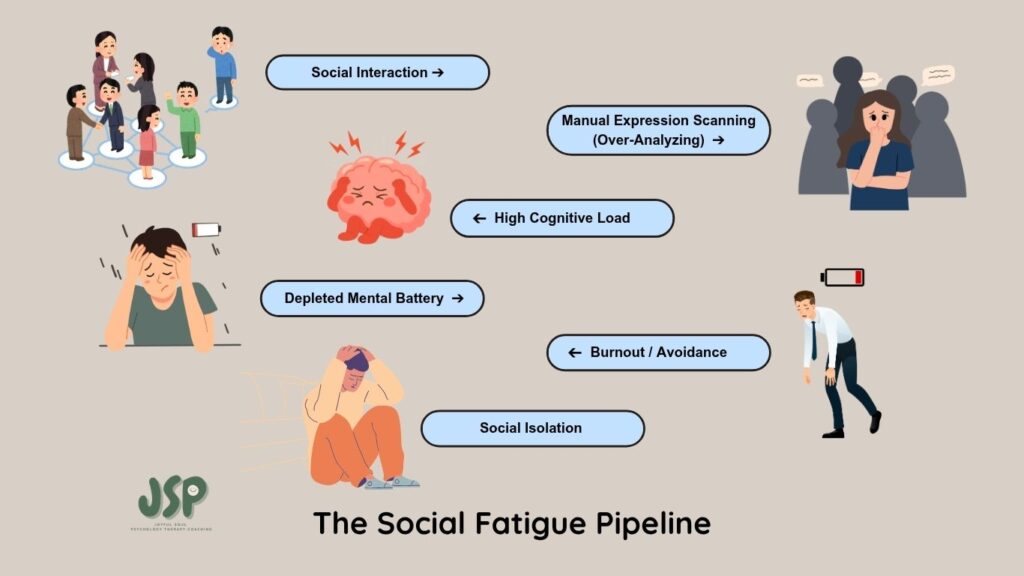
The individual must consciously scan facial micro-expressions, track shifts in body posture, decode vocal tones, and evaluate hidden social contexts simultaneously. Doing this for consecutive hours while trying to maintain your own posture and formulate appropriate responses creates massive cognitive load.
By the time the individual returns home, their mental battery is completely drained. This burnout often forces them to seek total isolation to recover. Parents may mistake this defensive withdrawal for a behavioral problem or a lack of social effort, which adds emotional pressure to a young person who is already feeling socially defeated.
Social Tracking and Interpersonal Affective ToM
To understand why real-time communication feels so draining, we have to look at the neurological pathways governing empathy and perspective-taking. Theory of Mind (ToM) allows us to understand internal mental states. While the cognitive branch tracks factual beliefs and logical intents, the Interpersonal Affective Theory of Mind branch focuses on decoding what other people are experiencing emotionally in the present moment.
Interpersonal affective ToM acts as a real-time translator for human emotion. It enables a person to look at a peer’s furrowed brow, hear a slight drop in their voice, and immediately conclude: “They are feeling uncomfortable or rushed, so I should change the topic.”
For individuals experiencing neurodivergent communication difficulties, this translation software does not run automatically. When a lag occurs in this network, social tracking requires deliberate, analytical effort. The individual must manually solve the social equation using pure logic, rather than intuition.
This analytical processing can lead to a slight delay in reading social cues. Consequently, the individual may inadvertently over-share details, struggle to recognize when a peer is losing interest, find it hard to maintain natural conversational turn-taking, or misinterpret playful teasing as direct hostility. The constant fear of making these social errors creates a state of chronic hyper-vigilance, transforming casual interactions into a source of panic.
Comprehensive Checklist: Introversion vs. Social Cue Fatigue
When you are trying to determine whether your teenager or you yourself are experiencing authentic social cue fatigue rather than basic introversion, look for these indicators:
Avoidance of Ambiguous Gatherings: A strong willingness to attend highly structured events (like a board game night or a shared hobby group) but a complete avoidance of unstructured socialising (like open networking dinners or casual mingling).
Deep Cognitive Exhaustion After Socializing: Feeling physically weak, getting a headache, or experiencing brain fog after a social interaction, rather than just wanting quiet time.
Persistent Post-Interaction Rumination: Spending hours or days dissecting past conversations, analyzing every word, gesture, and reaction for potential hidden mistakes.
Literal Interpretation of Fluid Language: Consistently missing subtle changes in sarcasm, irony, or implied meaning during casual chats, leading to confusion when context shifts quickly.
Difficulty Balancing Interaction Dynamics: Finding it incredibly hard to balance listening, matching body language, and generating timely responses simultaneously, leading to conversational freezing.

Proactive Strategies: Navigating Social Landscapes Sustainably
Telling a young adult to “just put yourself out there” or forcing them to attend large social gatherings without a strategy is counterproductive. It will scale up their anxiety and reinforce their desire to isolate.
Instead, families and young adults can utilize these evidence-based, neuro-affirming strategies to build authentic connections without exhausting their mental reserves:
1. Explicitly Verify Social Ambiguity
When a peer’s reaction, text message tone, or boundary feels unclear, avoid falling into an over-thinking spiral. Teach and practice direct, casual verification. Using simple phrases like, “Just checking, did my comment just now come across the wrong way?” or “Just wanted to make sure we have the same understanding about this group task,” clears up social anxiety instantly. It replaces guessing with concrete data.
2. Implement Strategic “Social Battery” Management
Acknowledge that real-time social tracking takes immense neurological processing power. Treat your social capacity as a limited energy budget. When attending university seminars, family gatherings, or workplace events, pre-plan clear boundaries. Schedule a 10-minute quiet break away from the crowd halfway through, set a firm departure time, and guarantee a full day of low-interaction sensory rest afterward to let the nervous system fully recover.
3. Focus on Shared-Interest Communication Hubs
Do not force yourself or your teenager to master the art of generic small talk or unstructured mingling. Instead, focus social energy entirely on environments built around a specific shared passion (i.e. activity based) —such as a coding club, an art class, a robotics circle, or a structured sports team. Having a concrete, shared focal point provides an automatic conversational script, reducing the cognitive load required to navigate interpersonal dynamics.
The Next Step: Building Confident Social Frameworks
Social communication is not an unchangeable personality trait; it is a structural, multi-layered system of patterns that can be intentionally understood, practiced, and navigated on your own terms. True social confidence does not mean hiding your neurodivergence or mimicking neurotypical behaviors until you burn out. It means understanding your unique processing style, learning how to read the social landscape accurately, and setting healthy relational boundaries.
At Joyful Soul Psychology, we move away from traditional compliance-based training that forces individuals to perform unnatural social scripts. Our integrated clinical speech therapy, social communication training, and adult mental wellness services provide a safe, neurodivergent-affirming space. We help adolescents and young adults across Singapore break down complex social dynamics into logical frameworks, manage interaction anxiety, and build meaningful, lifelong peer connections.
Build genuine social connections without the exhaustion. Explore our specialised Social Communication & Speech Therapy Programs at Joyful Soul Psychology today, and take the first step toward confident interaction.
What’sApp +65 8835 3015 / Email contact@joyfulsoulpsychology.com / IG https://www.instagram.com/joyfulsoulpsychology/ / JSP Supports https://joyfulsoulpsychology.com/services/

