
Reading Between the Lines: How Second-Order Theory of Mind Dictates Corporate and University Success
During primary and secondary school years in Singapore, the roadmap to success is relatively structured and linear: you follow the syllabus, revise past-year papers, complete your homework, and your grades reflect your effort. But as adolescents and young adults transition into polytechnics, junior colleges, universities, or enter their first corporate internships and full-time jobs, the rules undergo a massive shift. Suddenly, academic and career progress relies heavily on navigating unwritten organizational cultures, passive-aggressive emails, subtle power dynamics, group chat politics, and sarcastic humor.
For many parents and caregivers, it is bewildering to watch an academically brilliant young adult suddenly freeze, refuse to attend university seminars, drop out of project groups, or experience severe panic before work presentations. If you are the young adult navigating this intense transition, the psychological toll can feel overwhelming. You find yourself constantly second-guessing your colleagues’ intentions, reading excessive meaning into a brief text from a project group leader, or feeling like everyone else received a secret social instruction manual that you missed entirely.
These intense workplace and university social interaction challenges are not a sign of weakness or a sudden onset of incompetence. Rather, they highlight a developmental transition into a complex cognitive milestone: Higher-Order Interpersonal Cognitive Theory of Mind (ToM).

The Transition to Unstructured Environments and Hidden Intent
In a modern university lecture hall or a corporate office in Singapore, communication is rarely literal. When a project group leader texts, “Thanks for submitting the draft, it looks quite interesting,” or a corporate supervisor tells an intern, “Feel free to take your time on this, no immediate rush,” a neurotypical mind automatically decodes the subtext based on the environment. They realize that “interesting” might mean the draft is missing the mark, and “no immediate rush” usually means it is still expected by tomorrow morning.
For individuals facing neurodivergent processing differences, navigating these abstract grey areas creates immense cognitive friction. When a workspace switches from clear, explicit rules to fluid, unspoken expectations, a young person’s internal tracking system can easily become overloaded.
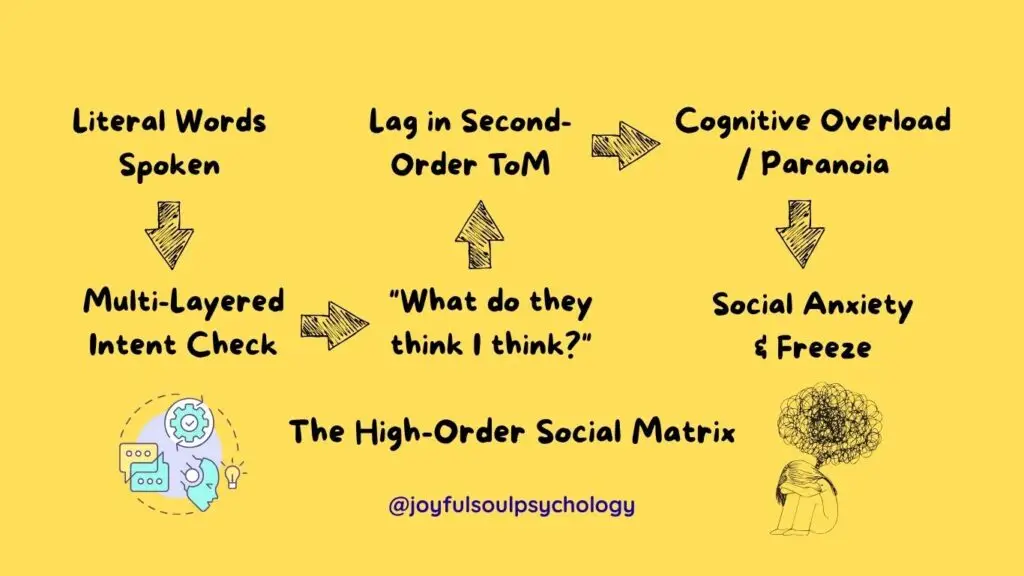
Instead of simply processing the words spoken, the individual must continuously guess the hidden motives of their peers and managers. When a brain struggles to decode this subtext reliably, it often lapses into defensive hyper-vigilance or complete withdrawal. Parents may interpret this avoidance as a lack of resilience or poor career drive, whereas the young adult is actually experiencing acute social burnout from trying to solve unresolvable social riddles.
Second-Order ToM and Performance Anxiety
To understand why advanced academic and professional social spaces feel so intimidating, we have to look at the transition from basic to complex perspective-taking. While first-order Theory of Mind allows a child to track a single layer of thought (“What does my teacher think right now?”), Higher-Order Interpersonal Cognitive Theory of Mind requires managing multi-layered, nested loops of thinking.
Higher-order ToM is the cognitive ability to track second-order beliefs: “What does Person A think that Person B expects me to do?” This advanced cognitive layer is the foundation for processing non-literal communication, such as corporate irony, white lies, strategic persuasion, and office diplomacy.
Neurobiological mapping reveals that advanced mentalising requires highly integrated connectivity across the temporoparietal junction (TPJ) and the dorsomedial prefrontal cortex (dmPFC). These neocortical networks act as a high-speed computer dedicated to social calculations.
When a developmental lag or processing divergence is present in this network, calculating these nested mental loops becomes exhausting. The young adult cannot confidently verify if a coworker’s casual comment is a friendly joke, a sarcastic critique, or a subtle warning.
This processing gap can manifest as taking constructive feedback as a total personal attack, missing critical office dynamics, or inadvertently breaking an unwritten corporate rule. The constant fear of making an invisible social error triggers intense performance anxiety, causing the amygdala to maintain a constant state of fight-or-flight that can freeze task execution and lead to chronic school or work avoidance.
Comprehensive Checklist: Universal Shyness vs. Higher-Order Interaction Deficits
To determine whether your teenager or you yourself are facing an authentic lag in higher-order perspective-taking rather than basic social shyness, look for these specific behavioral indicators:
- Extreme Literalism in Professional Settings: Routinely taking fluid, abstract, or metaphorical instructions literally, leading to significant task errors despite high intellectual ability.
- Paranoia Over Digital Communication: Experiencing intense anxiety when reading emails, Slack messages, or WhatsApp updates that lack explicit emotional markers like emojis or exclamation points, often assuming the sender is angry or disappointed.
- Difficulty Identifying Hidden Motives: Struggling to detect when a classmate or colleague is being manipulative, insincere, or insidiously critical, frequently taking pleasant surface expressions at face value.
- Meltdowns Triggered by Group Projects: Becoming completely overwhelmed during unstructured collaborative work where roles, expectations, and deadlines are not clearly assigned and documented in writing.
- Avoidance of Networking and Hierarchy: A deep dread of interacting with authority figures (such as professors or directors) or entering fluid social settings where clear conversational guidelines do not exist.
Proactive Strategies: Mastering the Professional and Academic Grey Areas
Advising an anxious young adult to “fake it until you make it” or lecturing them on the importance of networking will not repair a higher-order cognitive tracking gap. Increasing social pressure without providing structural tools only reinforces the individual’s anxiety and drives them toward long-term isolation.
Instead, parents, educators, and young adults can implement these structural, neuro-affirming strategies to navigate complex environments confidently:
1. Translate Abstract Prompts into Explicit Written Briefs
When dealing with ambiguous university assignments or fluid workplace instructions, do not guess at the hidden meaning. Protect your executive functioning by summarizing the conversation in a direct, factual email or text to your manager or project group. Use explicit clarifying phrasing: “To confirm my understanding of our discussion, I will prioritize these three specific milestones for our review next Tuesday. Please let me know if any adjustments are needed.” This shifts the task back from a social guessing game into a factual reference point.
2. Deconstruct Sarcasm and Office Dynamics Objectively
Treat social subtext like a logical data set rather than an intuitive mystery. When a confusing or emotionally charged interaction occurs, step back and analyze the context objectively with a trusted neutral party. Break down the scenario using logic: What is this person’s communication style? What are the structural goals of their department? What happened right before the comment was made? Mapping out these patterns helps bypass emotional panic and builds an intellectual roadmap for future interactions.
3. Establish Structured, Documented Work Roles
Whenever you or your teenager enter a collaborative group project or team framework, advocate for immediate structural clarity. Insist that all team roles, component deadlines, and task allocations are documented in a shared digital space. Having an objective, written single source of truth reduces the need for continuous, real-time social negotiations, allowing neurodivergent minds to allocate their cognitive energy directly toward execution rather than social tracking.

The Next Step: Cultivating Advanced Social Wellness
Thriving in Singapore’s university and corporate landscapes does not require changing your natural personality or forcing yourself to become an extroverted politician. Advanced social wellness means learning how to translate fluid, unwritten social rules into clear, logical systems that align with your processing style, while building protective psychological boundaries to manage performance anxiety.
At Joyful Soul Psychology, we understand that high academic capability does not automatically mean smooth social processing in unstructured environments. Our targeted young adult counseling, clinical therapy, and professional mental wellness coaching provide a safe, neurodivergent-affirming environment. We empower adolescents and young adults across Singapore to decode complex organizational cultures, navigate group dynamics confidently, and manage social interaction challenges without losing their authentic self.
Learn to read the unwritten rules of your environment with confidence. Book an advanced mental wellness consultation with our specialised team at Joyful Soul Psychology today, and transform your transition into adulthood.
What’sApp +65 8835 3015 / Email contact@joyfulsoulpsychology.com / IG https://www.instagram.com/joyfulsoulpsychology/ / JSP Supports https://joyfulsoulpsychology.com/services/

