
What’s setting you up for peer rejection?
In our previous post, The Unspoken Social Script, we looked at the exhausting tax of social cue fatigue. We uncovered how the transition into corporate and university “grey areas” forces neurodivergent minds to run manual, real-time tracking algorithms just to stay afloat.
But once you realize your social battery is draining, what do you actually do?
If you are a parent or an adult navigating ADHD, Autism, or social communication differences, you have probably been bombarded with well-meaning, traditional advice:
- “Just walk up and say hi!”
- “Just introduce yourself.”
- “Just look them in the eye.”
The unfiltered truth: This advice is clinically ineffective, socially risky, and often completely wrong.
When a neurodivergent teen or adult tries to execute these rigid scripts, they don’t blend in. They risk being perceived as abrupt or intrusive, which frequently triggers the devastating sting of peer rejection.
To break this cycle, we need to stop teaching abstract etiquette and start building functional, “ecologically valid” concrete skills.

We teach them the UCLA-backed gold standard of human connection.
The Flaw of “Just Say Hi”: The Anatomy of a Successful Conversation Entry
What does social success actually look like in the real world? It isn’t a performance. It is a highly formulaic, step-by-step sequence.
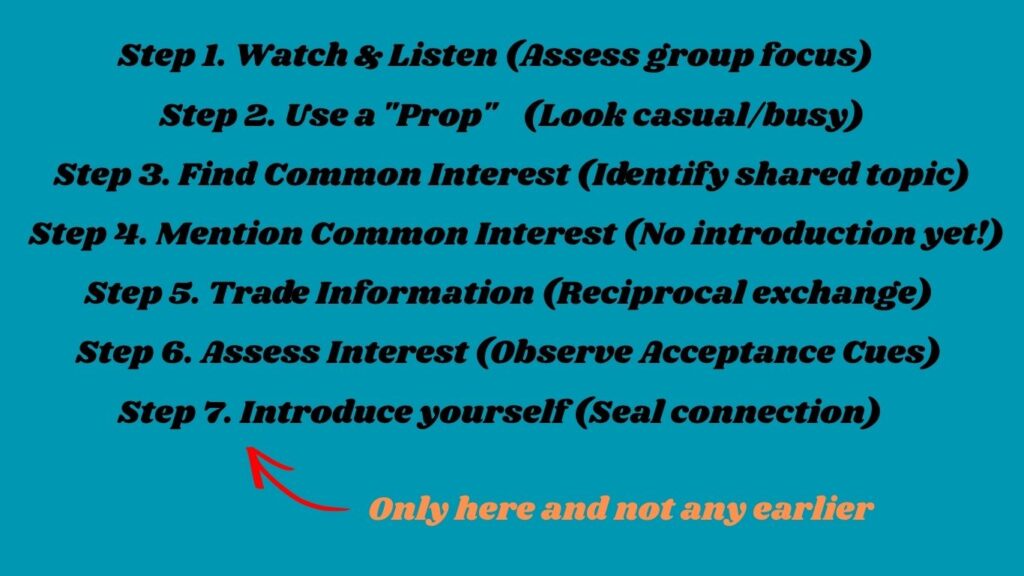
Consider the mechanics of entering a group conversation at a university lounge or a corporate pantry. Traditional advice tells you to break into the circle and introduce yourself. However, behavioral science shows that socially successful individuals use a completely different framework:
- Watch and Listen: Casually scan the room to check the group’s body language and see if the conversation is “open” or “closed.”
- Use a “Prop”: Looking at your phone, a notebook, or a beverage so you appear naturally occupied rather than intensely staring while listening.
- Find Common Interest: Identifying the topic being discussed without interrupting. Identify things you can talk about and you can do together. Find out what the other person does not like so you can avoid doing these things together.
- Mention the Common Interest: Contributing a short, relevant compliment or question about the topic, not about themselves.
- Trade Information: Only after the group welcomes the comment do they pivot to reciprocal information exchange and introductions.
- Assess Interest: You may need to make sure the person is interested in the conversation. Ask yourself these questions to assess interest:
- Are they talking to me?
- Are they looking at me?
- Are they facing me (or are they giving me the cold shoulder)?
- Introduce Yourself
This isn’t about masking or forcing a neurotypical persona. It is about decoding the functional mechanics of human connection so you can choose when and how to deploy them on your own terms.
From Analysis Paralysis to Micro-Muscle Memory
Knowing the steps intellectually is only half the battle. If you have executive dysfunction or high social anxiety, trying to recall these steps under stress causes instant cognitive overload. You cannot analyze your way out of a social communication bottleneck while it is happening.
Social communication is like learning to drive or playing an instrument. It requires micro-muscle memory. Hence, to truly move past social fatigue, you need an environment that provides:
- Real-Time Social Coaching: Practicing in a low-stakes, safe environment where feedback is clear, predictable, and entirely free of judgment.
- Ecologically Valid Rules: Learning what people actually do, not what people say you should do.
- Controlled Role-Playing: Watching clinical experts demonstrate both the “socially risky” way and the “socially helpful” way.
Build Lasting Social Confidence: The PEERS® Method
If you or your adolescent are ready to stop guessing the social script, the answer lies in structured, evidence-based systems.
At Joyful Soul Psychology, we run Singapore’s premier in-person PEERS® Social Skills Programme. Developed originally at UCLA by Dr. Elizabeth Laugeson, PEERS® is the world’s gold standard for evidence-based social skills training. It is explicitly designed for motivated teens (12 – 17) and young adults (18 – 35) looking to navigate friendships, university life, and workplace relationships.
Led by our certified practitioners, we break down the complex mechanics of human connection into simple, functional milestones:
- Conversational Fluency: How to start, maintain, and exit conversations naturally.
- Managing Rejection & Conflict: Concrete steps to navigate drama, teasing, disagreements, and gossip safely.
- Building Networks: Finding your crowd, organizing successful get-togethers, and understanding digital texting etiquette.
Social connection shouldn’t feel like a locked room without a key. Let’s build the concrete systems that unlock genuine confidence, completely on your own terms.
Ready to transform social confusion into predictable, structured success? Seats are highly limited to preserve our small group dynamics (2 to 5 participants). Explore our program details and secure an intake interview today.
What’sApp +65 8835 3015 / Email contact@joyfulsoulpsychology.com / IG https://www.instagram.com/joyfulsoulpsychology/ / JSP Supports https://joyfulsoulpsychology.com/services/

