
The Invisible Weight of “Holding It Together”
We meet clients every day who are completely exhausted. Often, this deep exhaustion does not stem from personal weakness. It comes from the invisible weight of “holding it together” in a complex world.
When we look at how human connection shapes the nervous system, one of the most critical therapeutic shifts we can make in daily life is understanding the clinical, behavioral, and systemic differences between “Empathy” and “Sympathy”. What we choose to offer others, and ourselves, directly alters neurobiology, shapes self-concept, and dictates whether our environments are truly inclusive.
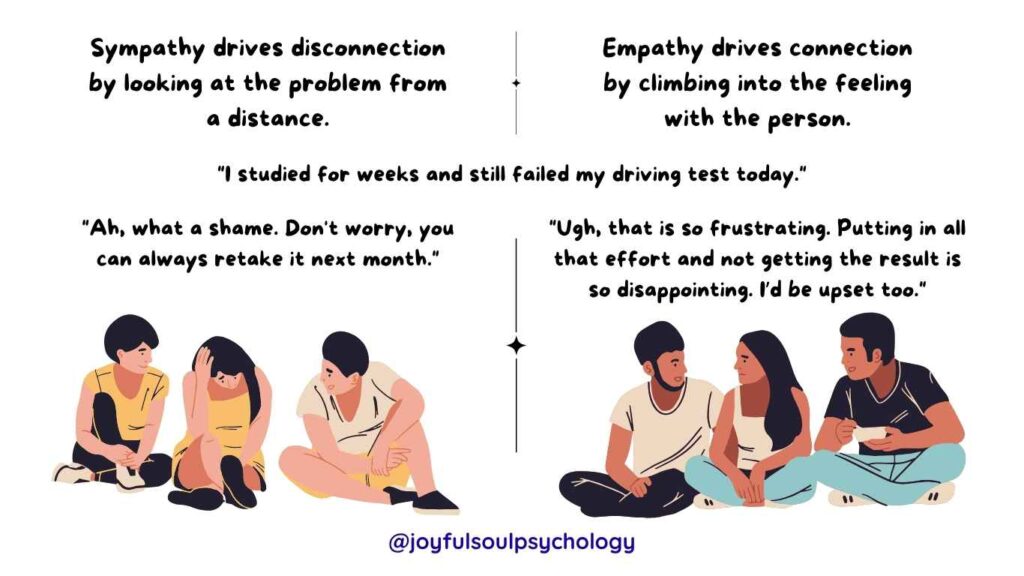
The Distinction: Mirroring vs. Detached Pity
To cultivate a truly affirming framework, we must map how these two responses operate internally and externally.
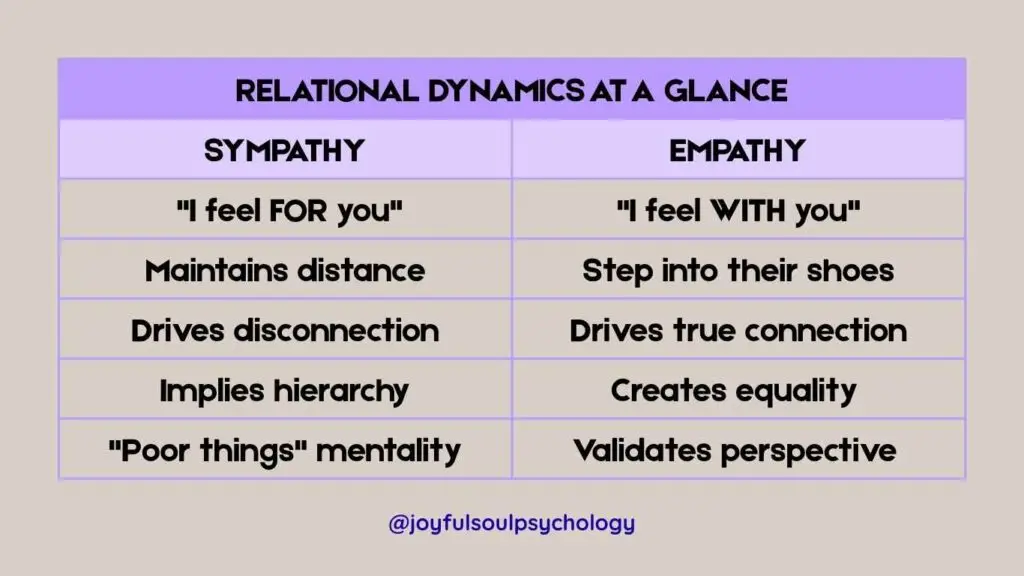
is the exact point where real behavioural shifts begin.
Sympathy: Feeling “For” Someone (The Distance of Pity)
Sympathy observes distress from a position of emotional detachment. It says, “I see your problem, and I feel sorry for you.”
- The Cognitive Loop: It preserves a boundary between the observer and the observed.
- The Impact on Self & Others: While well-intentioned, sympathy establishes a subtle hierarchy. The recipient is viewed as a victim, which can inadvertently fuel shame, highlight deficit-based thinking, and lead to masking. When applied to oneself (self-sympathy), it can devolve into self-pity or helplessness, where challenges are viewed as fixed, unchangeable flaws.
Empathy: Feeling “With” Someone (The Shared Space)
Empathy is a collaborative somatic and cognitive bridge. It requires a deliberate leap of imagination to sit alongside someone in their unique reality without judgment.
- The Cognitive Loop: It activates neural mirroring mechanisms, matching the emotional tone of the other person while maintaining stable emotional regulation.
- The Impact on Self & Others: Empathy fosters validation, psychological safety, and belonging. When we practice self-empathy, we honor our executive dysfunction, sensory overloads, or emotional burnout with kindness rather than harsh criticism. It changes our internal dialogue from “I am unreliable” to “My brain is full, and I am managing a heavy cognitive load”.
JSP’s insight
Shifting from self-sympathy to self-empathy is the exact point where real behavioural shifts begin.
Circumstance Mapping: When to Use Which?
A calibrated informed life does not discard sympathy entirely. Both responses serve distinct situational functions, depending on emotional bandwidth, roles, and safety boundaries.
When to Utilize Sympathy
Sympathy is highly effective when “healthy emotional distance is required for safety”, or when deep relational engagement is impossible.
- Casual or Formal Contexts: Expressing condolences to a distant acquaintance or managing brief, transactional service encounters.
- Preventing Empathy Fatigue: In crisis management, helping professionals use clinical sympathy as a protective barrier to avoid emotional burnout while still delivering essential support.
- Setting Boundaries: When a client’s or colleague’s dysregulation threatens your own psychological safety, sympathy allows you to acknowledge their distress without absorbing their nervous system’s chaos.
When to Utilize Empathy
Empathy is required for “co-regulation, behavioural growth, healing, and skill-building”.
- Navigating Neurodivergence: Supporting individuals with ADHD, Autism (ASD), or speech and language processing differences requires stepping into their specific sensory and executive reality.
- Deepening Trust: Rebuilding fractured relational dynamics or anchoring collaborative projects.
- Facilitating Behavioral Change: Supporting a client or child through a meltdown, a period of intense executive overwhelm, or vulnerability.
Situational Prompts: Calibrating Our Language
1. Toward Yourself (Self-Compassion & Intrapersonal Growth)
- Sympathetic Pity: “It’s so sad that I can never stay organised like everyone else. I am just a broken person.”
- Empathetic Prompt: “What sensory or executive demands did I face today that drained my battery? It makes complete sense that I am feeling overwhelmed right now.”
2. To Your Child (Parenting with Co-Regulation)
- Sympathetic Pity: “Oh dear, look at you crying over a simple puzzle. Don’t worry, let me do it for you, poor thing.”
- Empathetic Prompt: “This puzzle is feeling incredibly frustrating right now, isn’t it? Your brain is working so hard. Let’s take a deep breath together and look at it as a team.”
3. To Your Student (Neurodivergent-Affirming Education)
- Sympathetic Pity: “I feel so sorry for him; his ADHD makes it impossible to sit still. Let’s just excuse him from the writing assignment.”
- Empathetic Prompt: “I notice your body needs to move right now to help you process information. Let’s try using a wobble stool or a fidget tool while we work through this paragraph together.”
4. To Your Colleagues (Peer Support & Collaboration)
- Sympathetic Pity: “Sucks that management shifted your deadline again. Good luck with that nightmare.”
- Empathetic Prompt: “It is incredibly stressful when the goalposts move unexpectedly after you’ve poured energy into a project. How can we re-strategize, or do you just need a safe space to vent?”
5. To Your Subordinates (Empathetic Leadership)
- Sympathetic Pity: “I see you are drowning in this workload. I feel bad, but we all have to push through the pain.”
- Empathetic Prompt: “I hear how heavy this workload is, and I want to support you. Let’s look at your task list together and figure out what we can safely deprioritize, delegate, or adjust.”
6. To Your Supervisors (Upward Communication)
- Sympathetic Pity: “You look completely exhausted by these boardroom meetings. I feel so bad for you leaders.”
- Empathetic Prompt: “I recognise that balancing these organisational changes puts a significant amount of pressure on you. I’ve structured this project summary clearly to save you time and ease that load.”
Cultivating True Inclusivity Through an Empathetic Lens
Living life through the distinct lens of empathy is the foundation of genuine social and structural inclusivity.
When communities operate out of mere “sympathy”, they design spaces out of pity. They treat accommodations as charitable gestures or exceptions to the rule, which leaves marginalised or neurodivergent individuals feeling like external burdens. Sympathy looks at an autistic person or an individual with an ADHD diagnosis and says, “Let’s accommodate them because they are less fortunate.”
Conversely, “empathy” actively deconstructs those barriers. It recognises that human minds, communication styles, and nervous systems naturally vary. Empathy alters the environment rather than forcing the individual to mask their true self. It builds ramps, integrates visual schedules, normalises sensory downtime, and adopts flexible workplace standards because it genuinely respects different ways of being.
JSP’s insight
By choosing empathy over sympathy, we move beyond passive pity into a state of active, shared humanity. We stop looking down at people, and instead, pull up a chair to sit beside them.
From Accommodation to a Universal Human Baseline
But if we restrict empathy merely to how we treat marginalised or neurodivergent individuals, we miss its true transformative power. To create spaces where everyone thrives, we must scale this concept up.
The Three-Dimensional Ecosystem of Empathy
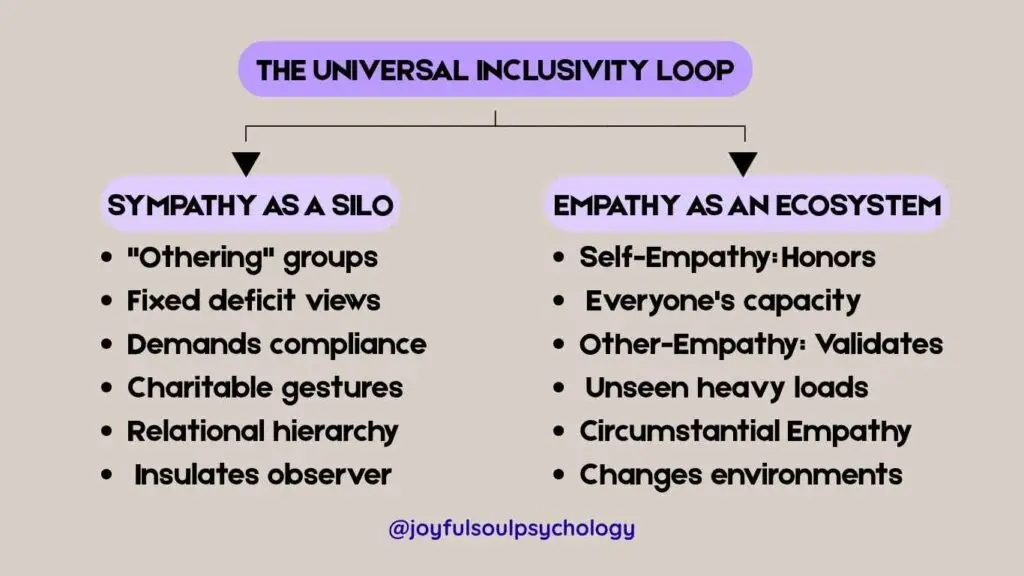
True inclusivity cannot be siloed, it must operate as a three-dimensional ecosystem of empathy.
- It requires self-empathy, where we grant ourselves the grace to navigate our own cognitive fatigue and fluctuating capacities without harsh judgment.
- It demands an active “empathy for others”, recognizing that every individual we encounter is managing their own unseen neurobiological or emotional loads.
- Finally, we must practice “empathy for circumstance”. This means acknowledging that systemic setups, sudden environmental changes, and historical barriers directly dictate a person’s ability to cope at any given moment.
When we cultivate this holistic lens, empathy stops being just an accommodation we hand out to neurodivergent individuals. Instead, it becomes a universal baseline that honors the entire spectrum of human vulnerability and resilience.
passive pity into a state of active, shared humanity.
Ready to Experience Affirming Support?
We don’t look down at you with sympathy. We sit beside you with evidence-based empathy. Whether you are a professional navigating executive dysfunction, a parent looking to co-regulate with your child, or an adult seeking clarity post-diagnosis, our team is here to support you.
- Psychology & Counselling: Process emotional challenges and heal from masking in a safe, affirming space.
- Speech & Language Therapy: Enhance your real-world communication skills and build language confidence.
- Specialized ADHD & ASD Coaching: Master executive functioning, time management, and everyday productivity with strategies that work for our unique brain.
Take the first step toward a collaborative, supportive partnership today.
What’sApp +65 8835 3015 / Email contact@joyfulsoulpsychology.com / IG https://www.instagram.com/joyfulsoulpsychology/ / JSP Supports https://joyfulsoulpsychology.com/services/

