
Every parent knows this feeling
Every parent of a neurodivergent child knows the feeling. You read about the incredible benefits of LEGO®-Based Therapy. You see how it scaffolds natural communication. Intrigued, you dump a fresh box of bricks on the living room rug, hoping for a breakthrough in teamwork, sharing, and speech. Instead, within ten minutes, someone is crying. One child wants total control, another walks away in frustration, and the bricks are left scattered.
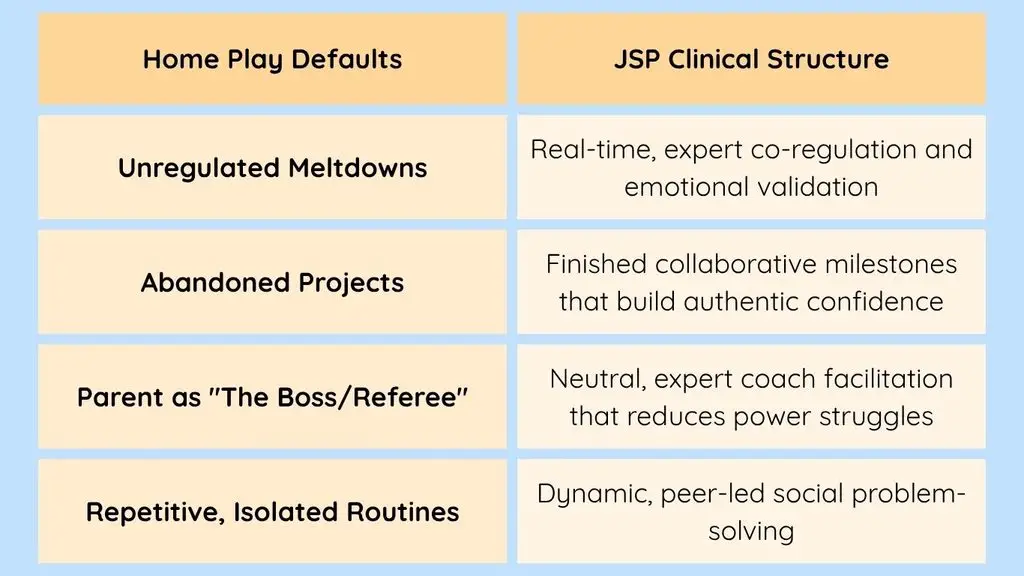
If your attempts at home reinforcement feel less like “bonding” and more like refereeing a meltdown, you are not alone. While practicing skills at home is highly valuable, there is a distinct clinical reason why casual play at home cannot replicate the transformative results of a structured therapeutic environment.
Here is why your child needs a professional social lab, and how it unlocks the communication breakthroughs you’ve been waiting for.
The Origins of LEGO®-Based Therapy
To understand why home play defaults to frustration, we have to look at the clinical origins of this methodology. Developed by pediatric neuropsychologist Dr. Daniel LeGoff, LEGO®-Based Therapy was not designed as an unstructured playdate. It is an evidence-based play therapy model engineered to leverage a child’s natural strengths, such as predictability, systemising, and structure, to facilitate collaborative social interaction.
For a child with ADHD, Autism, or speech and language differences, the brilliant design of a plastic brick lies in its consistency. It always fits together the same way. There is no social ambiguity in a brick. However, the human interactions surrounding the bricks are highly ambiguous, and that is where casual play breaks down.
The Missing Blueprint: Why Casual Play Isn’t Therapy
Without intentional, clinical micro-scaffolding, a simple building session presents an overwhelming amount of unstructured social data, causing a child’s system to overload.
- The Safe Space Bias: Children naturally let their guard down at home. While healthy, it means they are highly likely to default to old, comfortable defensive habits rather than pushing themselves to try demanding new communication strategies.
- The Executive Functioning Trap: Assigning collaborative building roles sounds simple in theory. In reality, moving between listening, planning, and executing requires immense cognitive flexibility. Without an objective coach to co-regulate this transition, emotional dysregulation takes over.
- The Proximity Illusion: Putting children in the same room with the same toy does not automatically equal social connection. Neurodivergent minds frequently engage in parallel play (playing beside someone). They need explicit, neurodiversity-affirming support to transition into collaborative play (playing with someone).
Anatomy of the Social Lab: The Three Roles
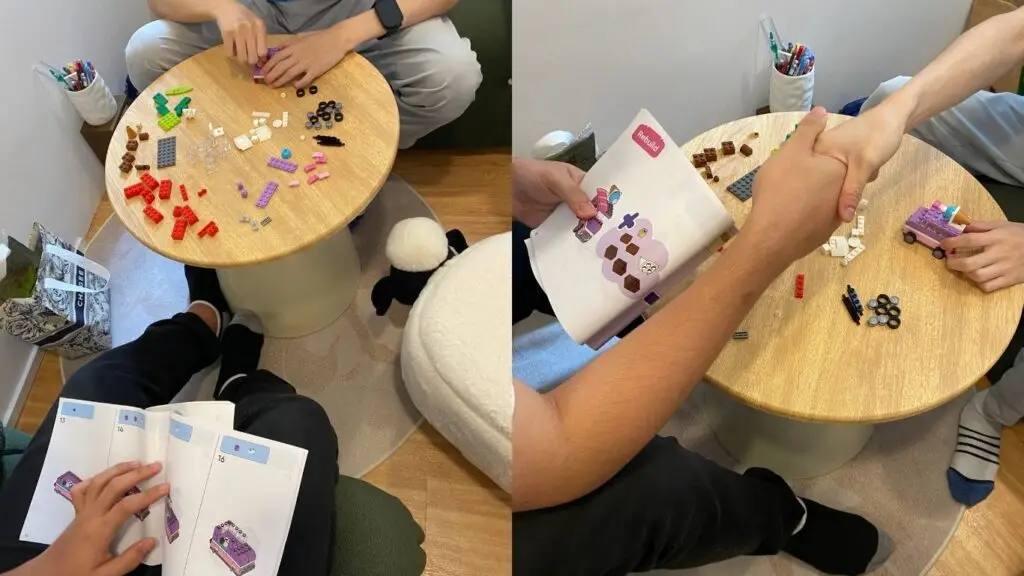
Inside a professional group session, the chaos of a toy box is replaced by a structured system. Participants work in groups of three, and every participant has a vital, interdependent role:
- The Engineer: Holds the instructions. They must use precise descriptive language to explain which brick is needed and where it goes, without pointing or touching the bricks themselves. This builds expressive language and spatial reasoning.
- The Supplier: Holds the bricks. They must listen carefully to the Engineer’s description, locate the correct piece, and pass it to the Builder. This builds receptive language, active listening, and categorization skills.
- The Builder: Holds the model. They take the piece from the Supplier and follow the Engineer’s verbal directions to assemble the structure. This builds fine motor coordination, perspective-taking, and multi-step direction following.
Because no single participant can complete the project alone, they are forced to communicate. If one person stops communicating, the whole project stops. This creates a natural, low-stakes motivation to connect.
Inside the Social Lab: The Professional Advantage
In our dedicated Speech & Language Therapy and specialized group programs at Joyful Soul Psychology, we transform toy bricks into a precise social communication laboratory.
When your child steps into our professional group, they practice real-world communication with supportive, clinical frameworks:
1. Immediate, Real-Time Co-Regulation
When a conflict arises, e.g. a misplaced brick or a misunderstood instruction, our trained therapists do not step in to simply fix the problem or demand compliance. We slow down the interaction, guiding children to explore mutual perspective-taking, recognise peer responses, and express frustration using clear, supportive language frameworks.
2. Tailored Speech and Language/ Social Behaviour Scaffolding
As a neurodiversity-affirming practice, we meet your child exactly where they are. Whether they need support structuring complex sentences, practice listening to multi-step instructions, or assistance navigating non-verbal communication, an expert clinician modifies the interaction in real time to match their unique profile.
3. Peer-to-Peer Motivation Without the Friction
Children respond differently to peers than they do to parents. Within a structured peer group, the desire to complete a shared, exciting goal serves as a powerful motivator. They learn to negotiate, compromise, and celebrate shared success with equals, building authentic social confidence that carries over to the school yard.
From Bricks to Real-World Bonds
The ultimate goal of therapeutic play isn’t perfectly assembled plastic sets. It is the development of a resilient, authentic communication toolkit.
By shifting the heavy lifting of behavior tracking, social cueing, and language structuring to a professional coach, you allow your child to learn systematically in a safe, affirming environment. You can return to simply being a supportive parent, watching their communication skills flourish naturally.
Ready to See Real Progress?
Don’t let social frustration hold your child back from building meaningful connections. Our evidence-based LEGO®-Based Therapy Programme at Joyful Soul Psychology gives neurodivergent and creative minds the structured, joyful environment they need to thrive.
Schedule a Brief 15-Minute Call with Our Intake Team Today.
Spaces are strictly limited per cohort to ensure optimal therapist-to-child ratios and personalized attention.
- Venue: Joyful Soul Psychology, 171 Tras Street, Union Building, #08-171A, Singapore 079025
- WhatsApp: +65 8835 3015
- Email: contact@joyfulsoulpsychology.com
Is LEGO® content proprietary? Trademark note
LEGO® is a trademark of the LEGO Group. We use the term descriptively to identify the therapeutic medium; the LEGO Group does not sponsor, endorse, or authorise this programme.
Further reading (academic & practical)
- Primary research & program manuals: LeGoff, D. B. (2004); LeGoff, D. B., Gómez de la Cuesta, G., Krauss, G. W., & Baron-Cohen, S. (2014); Legoff, D. B., Krauss, G. W., & Baron-Cohen, S. (2018); LeGoff, D. B. (2019 workshop materials). See full references below.
- Practitioner summary: Celestine, N. (2021, updated July 17, 2025). Lego Therapy: How Play Can Heal People (+ Resources). PositivePsychology.com. This accessible article provides downloadable worksheets and practical tips families often find helpful: https://positivepsychology.com/lego-therapy/

