Deconstructing a Breakthrough: Inside a Non-Directive OH Cards Session
EXECUTIVE SUMMARY
- The Intent: Moving past theory and ethical boundaries to provide a live, structural look at how an associative card session unfolds in real-time practice.
- The Case Study: A step-by-step narrative breakdown of a high-functioning executive client using projective tools to bypass an overthinking loop.
- The Clinical Value: Demonstrates exactly how utilizing external visual metaphors satisfies the highest non-directive standards of the ICF Core Competencies while protecting client pacing.
In our previous articles, we audited the strict ethical boundaries required for deep subconscious work and explored how to troubleshoot visualization resistance using external visual buffers. But for a professional coach, understanding the theory is only half the battle. The true artistry lies in watching the framework breathe in real-time execution while maintaining full alignment with the International Coaching Federation (ICF) Code of Ethics.
High-functioning clients possess highly resilient defense mechanisms. When a client protects their vulnerability with intellectual eloquence, our verbal questioning toolkits can hit a wall.
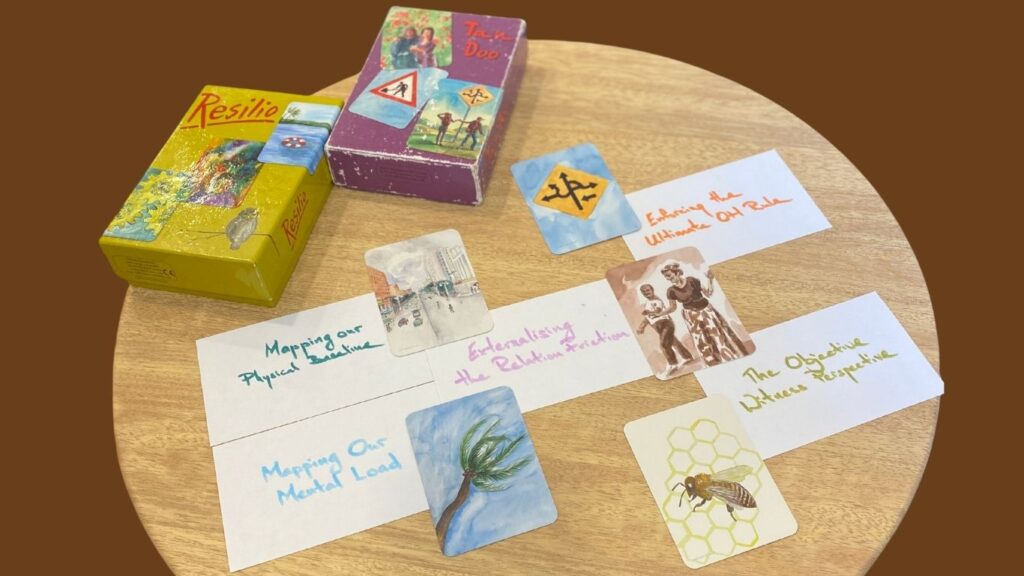
To demonstrate how to gracefully dissolve this friction without crossing the line into clinical regression, let us pull back the curtain on a real-time, non-directive coaching session engineered around pure ICF competency markers.
around pure ICF competency markers
The Client: An Executive Sidelined by the Inner Critic
The Context: “Paker” is a senior director preparing for an international keynote presentation. Despite a stellar track record, he enters the session experiencing severe imposter syndrome, high cognitive anxiety, and executive paralysis.
The Talk Loop: For the first ten minutes, Paker loops in his analytical mind. When asked what is holding him back, he delivers a perfectly polished corporate script: “I just need to refine my slide decks. I need to practice my pacing. I am simply feeling the typical pressure of a high-stakes environment.”
Paker knows his problem intellectually, but his analytical ego is acting as a shield, keeping him trapped in a loop of overthinking. Verbal questioning is failing to spark an insight because Paker is choosing words that keep him feeling safely in control.
Recognizing the logjam, the facilitator introduces the OH Cards framework to establish cognitive distance and invite a new level of client-led discovery.
The Session Mechanics: Bypassing the Shield Step-by-Step (Simplified version)
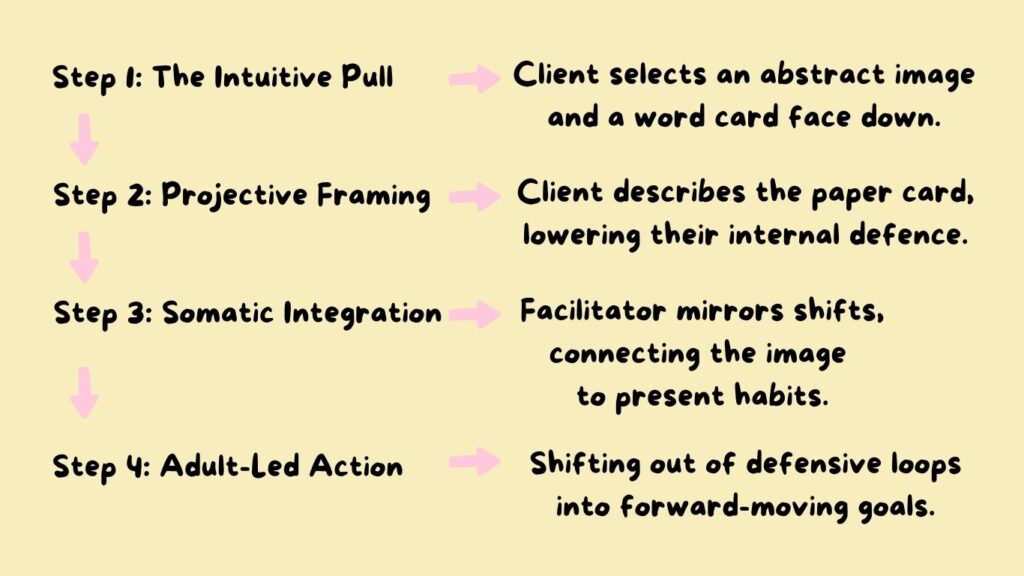
Step 1: The Intuitive Selection
The facilitator invites Paker to pull one picture card and one word card from the OH deck without overthinking, allowing the client to co-create the session tool [ICF Core Competency 3: Establishes and Maintains Agreements]. Paker places them face up on the table.
- The Picture Card: An abstract illustration of a solitary figure standing at the edge of a vast, foggy chasm.
- The Word Card: The word “PRESSURE” framing the image.
Step 2: Evoking Open Projection
Instead of asking Paker what the card means about his keynote speech, which might be a leading prompt, the facilitator uses clean, neutral language to prompt an objective observation:
- Facilitator: “Look at the combination on the table. Without trying to fix it or analyze it, tell me what story unfolds within that frame?” [ICF Core Competency 7.4: Asks questions that help the client explore beyond current thinking]
- The Client’s Shift: Paker stares at the physical card. Because the imagery sits on the table outside of his mind, his inner critic lowers its guard. He is no longer on the defensive.
- Paker: “The person on the edge looks completely isolated. They feel like if they take one step forward, they will drop into the dark. The word ‘Pressure’ isn’t coming from the chasm… it’s a heavy weight pushing down on their shoulders from above.”
Step 3: Somatic and Metaphorical Mirroring
The facilitator notices Paker’s shoulders drop slightly and his breathing switch from shallow to deep, practicing active listening that goes beyond verbal vocabulary.
- Facilitator: “I notice your breath changed as you described that heavy weight from above. As you look at that figure on the edge, who or what is generating that pressure?” [ICF Core Competency 6.3: Acknowledges and reflects the client’s emotions, energy shifts, or somatic changes]
- Paker (Pausing, looking deeply at the card): “It’s not the audience. It’s an old rule. It’s the voice that says if this presentation isn’t absolutely flawless, everything I’ve built will disappear. It’s a hyper-vigilant kid trying to keep me safe from making a mistake.”
Through spontaneous projection, Paker has bypassed his corporate script. He has objectively mapped out his automated emotional blueprint, identifying his inner critic not as a clinical pathology, but as an outdated protective program running in his background.
(Ethical Scope Check: Notice that Paker explores a childhood metaphor, but the facilitator deliberately keeps the session out of historical trauma processing or family regression, honoring ICF Ethical Standard 1: Operating strictly within competence).
Step 4: Activating Adult-Led Presence
Now, the facilitator pivots the session trajectory firmly toward future-focused growth, stepping out of past history and into present agency:
- Facilitator: “Looking at that worried part of you on the card with kindness. As the capable, clear-headed adult sitting in this chair today, what does that part need to hear from you right now to know it doesn’t have to carry the weight of this keynote?” [ICF Core Competency 7.5: Invites the client to share more about their experience in the moment]
- Paker: “It needs to know that I’ve got this handled. I have over fifteen years of experience. I don’t need to be flawless to be safe anymore.”
- Facilitator: “Let’s take a deep breath and anchor that feeling. From this grounded space of your Adult Self, what is the very first, logical step you want to take toward your presentation preparation this week?” [ICF Core Competency 8.1: Invites the client to translate insights into actions]
Note: If a client experiences a downward emotional loop during independent reflection, apply our 4-Step Emergency Grounding Protocol immediately.
The Post-Mortem: Mapping the Session to Advanced ICF Performance Markers
Why did this session yield a profound behavioural pivot in a brief moment? Let us look at how the process matches the rigorous standards of an advanced ICF performance evaluation:
- Pristine Non-Directive Presence (Competency 7: Evokes Awareness): The facilitator did not interpret the card, diagnose Paker with a childhood wound, or introduce an external hypothesis. By asking, “What story unfolds within that frame?”, the facilitator kept their linguistic footprint remarkably low ([ICF Competency 5.3: Actively maintains a state of not-knowing]). The tool did the heavy lifting, ensuring the breakthrough was 100% client-generated.
- Somatic Active Listening (Competency 6: Listens Actively): The breakthrough wasn’t catalysed by chasing Paker’s words; it was catalysed by tracking his physical shifts (his dropped shoulders and changes in breath) as he interacted with the external metaphor.
- Immediate Action Integration (Competency 8: Facilitates Client Growth): The session did not stay looping in past historical dynamics or emotional regression. It harvested the subconscious insight to instantly build a practical, adult-led behavioural workflow for his upcoming professional goals.
Upgrade Your Practice: Learn from the Lineage with Moritz Egetmeyer
Integrating projective, associative tools into our existing practice requires precision, safety boundaries, and a deep respect for client autonomy. Reading a session case study offers a glimpse of the potential, but experiencing the live mechanics under master facilitation transforms our entire clinical identity.
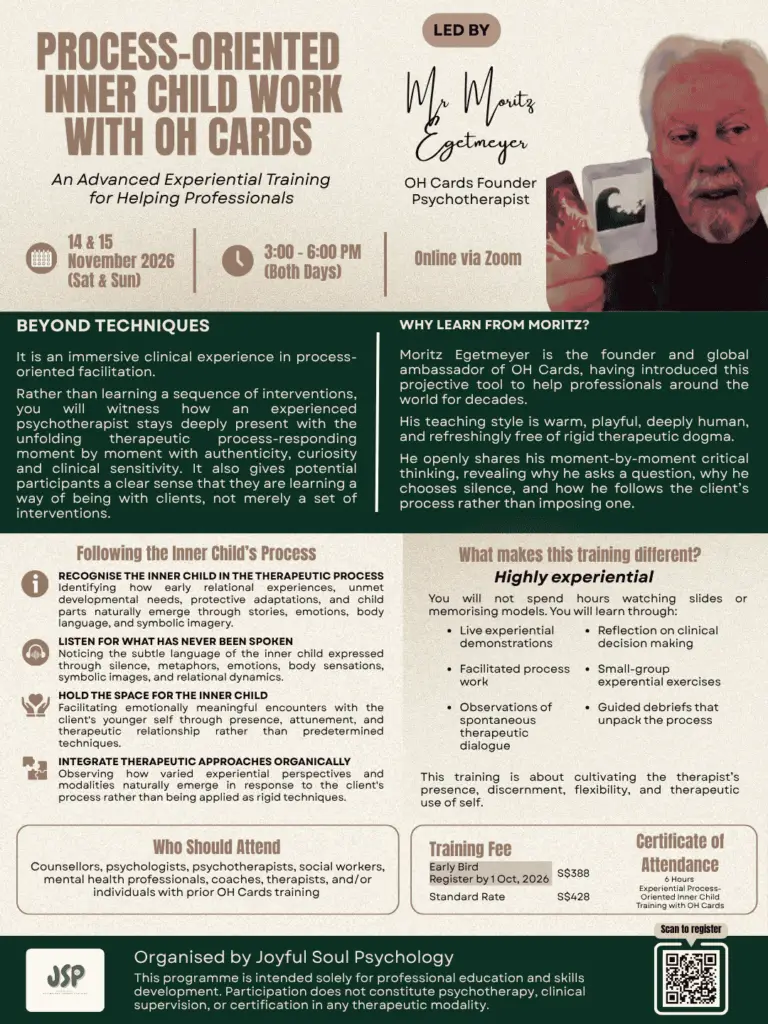
Join us at Joyful Soul Psychology for an immersive, experiential training featuring Mr Moritz Egetmeyer, the global founder of the OH Cards modality.
In this rare workshop, you will learn firsthand how to use this non-directive canvas to melt client analytical resistance, confidently navigate nervous system pacing, and protect your ethical boundaries while facilitating deep transformations.
Register for the upcoming inner child work with OH Cards training by Mr Moritz = https://forms.gle/pTnyQztjYkRQzSd67
Email us jsp.wyeo@gmail.com or WhatsApp +65 8835 3015; Check out JSP IG = https://www.instagram.com/p/DQCC3_DAs1j