Beyond Guided Imagery: How OH Cards Solve Client Visualisation Resistance
EXECUTIVE SUMMARY
- The Problem: Many highly analytical, intellectualising, or guarded clients freeze or experience intense resistance during guided imagery, somatic tracking, or inner child work. Closing their eyes to look inward often triggers hyper-vigilance or an active inner critic.
- The Clinical Reality: This roadblock might possibly be driven by aphantasia (the inability to create voluntary mental imagery) or subconscious defence mechanisms like intellectualisation and emotional detachment.
- The Solution: This guide outlines practical, verbal workarounds to bypass cognitive resistance without forcing internal imagery, and explains how physical, associative OH Cards serve as a safe, external tool for projective distance.
Whether you are a psychologist, counsellor, clinical social worker, or credentialed coach, hitting a wall with an intellectualising client is a common challenge. We can see the structural defence mechanisms, systemic behavioural loops, or early maladaptive schemas driving their perfectionism or anxiety. Yet, traditional deep-work interventions, like guided imagery, chair work, or regression techniques, can stall completely.
When we ask a highly guarded client to close their eyes and connect with a vulnerable or younger part of themselves, they often freeze, become intensely self-conscious, or state, “I don’t see anything.”
This clinical pushback might stems from two distinct factors:
- Aphantasia: A neurological variation where an individual genuinely lacks a “mind’s eye” and cannot produce voluntary visual imagery. For these clients, forcing an internal visualization is physically impossible and creates intense performance anxiety.
- Cognitive Defenses: Intellectualisation, rationalisation, and emotional detachment are highly effective armour. Forcing these clients to close their eyes strips away their psychological sense of control, instantly triggering their defences to protect them from perceived vulnerability.
Ethical, effective practice requires meeting clients exactly where their nervous system is regulated. If a client resists traditional internal visualisation, we need a flexible toolkit of non-linear workarounds to safely uncover unconscious insights.

Clinical Verbal Workarounds for Analytical Resistance
When a client pushes back against guided imagery, maintain a neutral, regulating presence and naturally pivot to another approach. Among possible approaches, here are three:
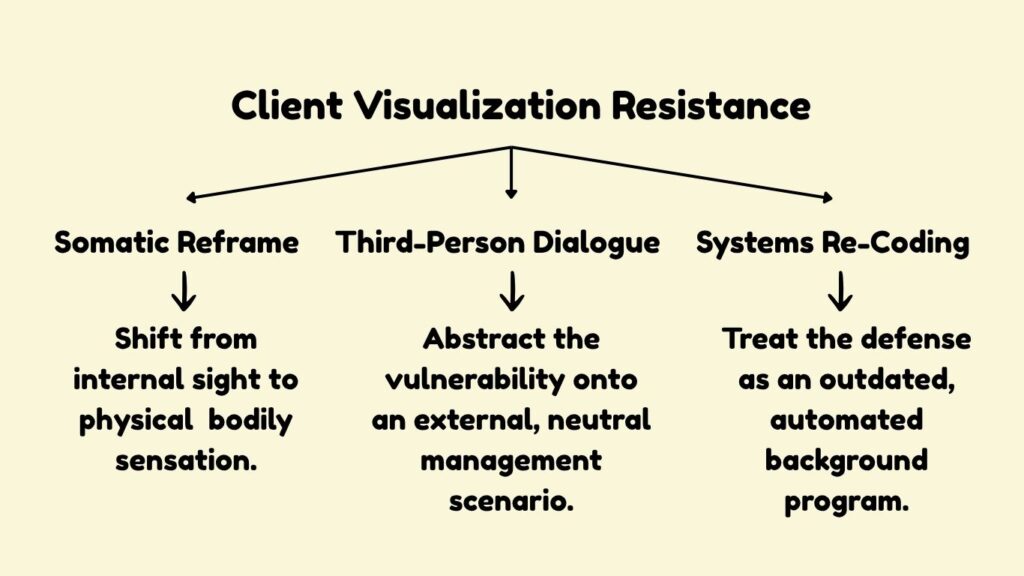
1. The Somatic Reframe
If a client cannot visualise, they can likely track physical sensation. Shifting from internal sight to somatic data bypasses the analytical filter.
- Prompt: “That is completely fine. You don’t need to see a picture in your mind at all. Let’s focus on what is happening physically instead. When you think about this boundary issue, where do you notice that tight knot of tension in your body right now? … If that physical tightness had a voice, what is it trying to warn you about or protect you from?”
2. The Third-Person Dialogue
Intellectualizing clients prefer processing problems logically. If they resist imagining their own vulnerable parts, abstract the dynamic onto an external, hypothetical scenario.
- Prompt: “Let’s skip the imagination entirely and look at this structurally. Imagine your best friend who is exceptionally talented but completely terrified of making a mistake on this launch. How would you support him/her? … Good. Now, how can we apply that exact same management strategy to your own internal pressure this week?”
3. The Systems Re-Coding Alternative
Turn emotional patterns into a clinical assessment or a systemic data problem to naturally engage a highly rational, analytical brain.
- Prompt: “It sounds like visualisation isn’t the right fit for your processing style. Let’s look at this pattern as an automated operating system running quietly in the background. It was coded a long time ago to keep you safe from criticism. What are the specific safety parameters this old program is trying to enforce right now, and how can we update the code today to match your current adult goals?”
Looking for individualized support? Explore our 1-to-1 OH Cards Consultation services at Joyful Soul Psychology.
The Power of Projective Distance
While verbal workarounds are highly effective, the most elegant clinical solution for visualisation resistance is shifting from internal generation to external projection. This is where the OH Cards modality integrates into a practitioner’s toolkit.
Instead of demanding that a client generate a mental picture behind closed eyes, we place a physical, abstract image on the table in front of them. This shift fundamentally alters the psychological dynamic of the session:
- Honoring Absolute Autonomy: The foundational rule of the OH Card methodology states that the cardholder is the sole interpreter. The practitioner never analyzes, decodes, or diagnoses the card for the client. The client retains total control over the narrative, creating a profoundly empowering and safe clinical container.
- Creating a Safe Visual Buffer: Looking at a physical card provides immediate projective distance. Because the imagery sits on the table outside of the client’s mind, it acts as a visual buffer. The inner critic lowers its guard because the focus is safely directed at the card, not on their personal flaws or past pain.
- Bypassing Cognitive Filters: Associative cards trigger spontaneous, non-linear insights. The brain processes images exponentially faster than spoken language. When an analytical client looks at an abstract picture paired with a word, their logical mind cannot instantly manufacture a curated, safe answer. Instead, their subconscious maps their internal emotional blueprint onto the card.
Pragmatic Subconscious Facilitation: Your Workshop Deliverables
To confidently facilitate deep breakthroughs with highly analytical, corporate, or resistant clients, we need an experiential framework that melts resistance while keeping our practice safely within professional boundaries.
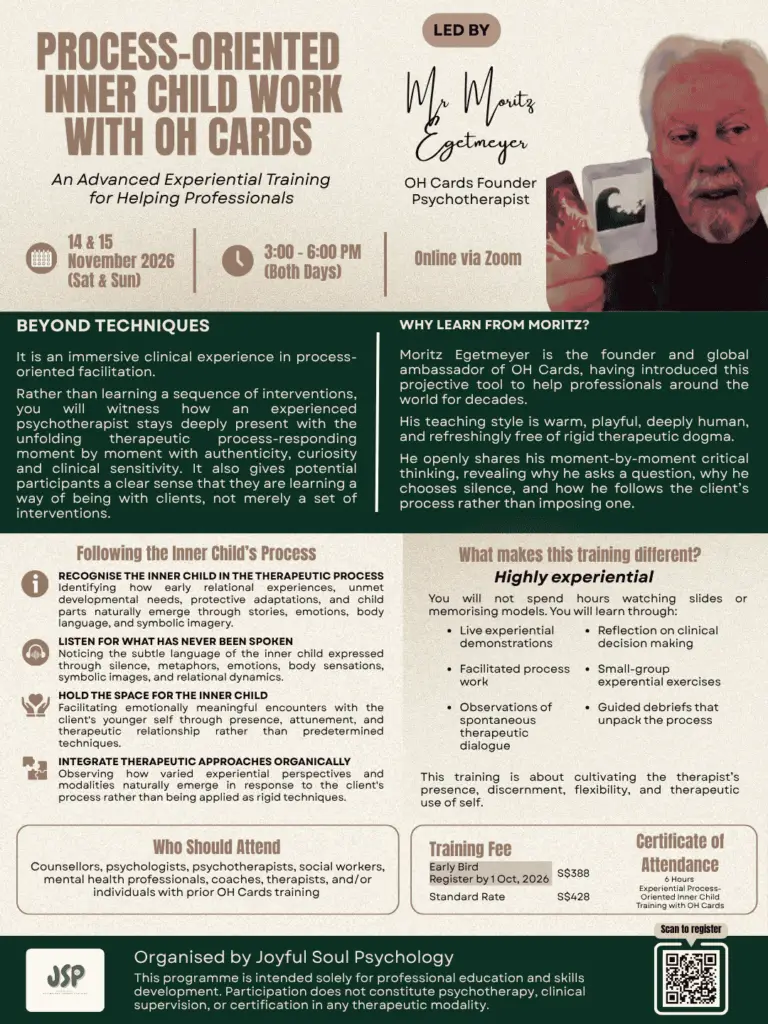
At our upcoming training, Mr Moritz Egetmeyer, the global founder of the OH Cards modality, will demonstrate how he translate associative frameworks into clinical mastery.
By participating in this live, interactive training, participants will acquire:
- The Non-Linear Framework: Practical, hands-on training on how to use word-and-picture card pairings to evoke profound awareness without triggering client defense mechanisms.
- Resistance Management: Mastering advanced projective workarounds to engage clients with aphantasia or heavy cognitive filters effectively.
- Session Security: Practical frameworks to safely manage the pacing of deep subconscious work, ensuring clients stay grounded and emotionally regulated.
- Modality Integration: Learn how to seamlessly integrate associative cards into our existing practice, whether we utilise CBT, Schema Therapy, Somatic Experiencing, or Executive Coaching frameworks.
Don’t let analytical blocks stall our client sessions. Upgrade our clinical toolkit with a methodology that turns resistance into sustainable growth.
Register for the upcoming inner child work with OH Cards training by Mr Moritz = https://forms.gle/pTnyQztjYkRQzSd67
Email us at jsp.wyeo@gmail.com or WhatsApp +65 8835 3015; Check out JSP IG = https://www.instagram.com/p/DQCC3_DAs1j