Why the Need and How to Safely Integrate Deep Frameworks Without Crossing the Clinical Line
EXECUTIVE SUMMARY
- The Problem: Analytical clients often hit a wall with surface-level coaching, yet ethical ICF coaches worry that deep tools—like inner child or somatic work—risk crossing the clinical line into therapy.
- The Solution: This guide introduces an objective, 3-point clinical audit (Locus of Control, Temporal Vector, and Nervous System Pacing) to safely integrate deep subconscious frameworks while staying 100% compliant with the ICF Code of Ethics.
- The Practical Takeaway: Learn how to map deep reflection directly onto the 8 ICF Core Competencies, execute an emergency 4-step grounding protocol to handle sudden client dysregulation, and discover why projective tools like OH Cards pass the compliance audit naturally.
As an ICF coach, our greatest tool is our own presence. Under ICF Core Competency 2 (Embodying a Coaching Mindset), we are called to maintain a rigorous practice of ongoing self-reflection. Exploring our own inner landscape isn’t just personal development; it is a professional prerequisite. When we reconnect with our own baseline of curiosity, innocence, and unburdened freedom, we expand our capacity to hold non-judgmental space for our clients. We learn to spot our own blind spots, prevent countertransference, and model the deep self-empathy required for sustainable growth.
However, many coaches hit a wall when attempting to bring deeper subconscious frameworks to their clients. While surface-level goal setting often stalls against repeating behavioral loops, coaches are deeply cautious, and rightly so, about violating ICF Core Competency 1 (Demonstrates Ethical Practice)
Whether we are using inner child work, somatic parts mapping, or values exercises, any client whose primary need is clinical therapy, trauma resolution, or psychological healing falls strictly outside the coaching scope of practice. The good news is that we do not have to avoid deep subconscious work to remain a compliant coach. What we need is an objective audit framework to keep our practice safe, ethical, and highly effective.

What Possibly is the “Inner Child” in an ICF Coaching Context?
To use this framework effectively, we must strip away the clinical jargon. In performance and executive coaching, the “inner child” is simply a functional metaphor for your client’s automated emotional blueprint.
During early developmental years, the human brain codes specific behavioural programs to navigate safety, validation, and belonging. As adults, these ancient programs don’t disappear, they operate in the background of our subconscious mind.
When a corporate client experiences sudden imposter syndrome before a presentation, or an executive reverts to people-pleasing during a conflict, they are not operating from logic. Their adult self has been temporarily sidelined by an activated, automated emotional response, the younger, self-protective part of their internal system.
By understanding the inner child not as a clinical pathology, but as an unconscious defensive program, a coach can help clients gently unmask these automatic triggers and consciously step back into adult leadership.
The Bright Side: Reframing Deep Tools for Future Goals
In popular psychology, working with deeper subconscious structures is almost synonymous with treating childhood wounds. In a strict ICF coaching container, we intentionally highlight the other side of the same coin: the unwounded, free-spirited self.
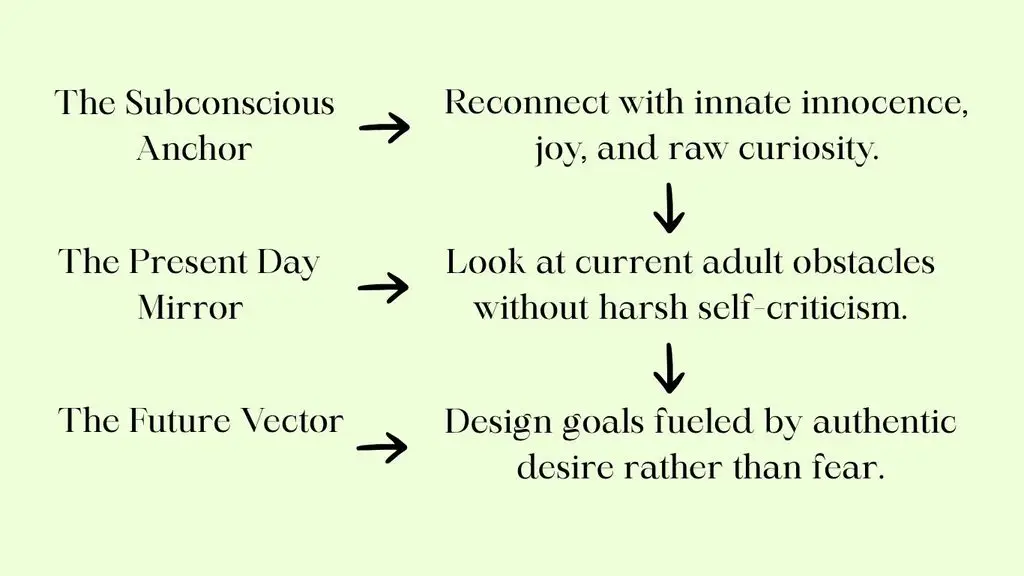
For example, our inner child holds our original blueprint of unconditioned joy, resilience, and curiosity. When we invite clients to tap into this part of themselves, we are not looking backward to heal a historic wound. Instead, we use that younger version as a living reminder of who they are at their core.
By anchoring clients in this vibrant energy, they can evaluate their present-day challenges and design their future goals with profound self-empathy and playful curiosity, rather than say rigid perfectionism.
A 3-Point Clinical Audit for ICF Compliance
To integrate any (advanced) tool or (subconscious) framework safely into our practice, let’s consider, for example, vetting it against these three strict boundaries:
- The Locus of Control (Interpretation vs. Projection)
- The Rule: Does the tool require the practitioner to analyze, label, or diagnose the client’s internal state?
- The ICF Alignment: To comply with a purely non-directive model, the meaning must belong entirely to the client. The coach acts as the facilitator of the process, never the expert on the client’s subconscious.
- The Temporal Vector (The “Why” vs. The “What Today”)
- The Rule: Does the tool pull the client into historical processing to treat past causes, or does it harvest present awareness to unlock future potential?
- The ICF Alignment: Coaching must look at the present to design the future. If a childhood dynamic or old messaging surfaces, the focus must immediately pivot to: “How is this automatic pattern showing up in your choices today, and what does your adult self want to choose moving forward?”
- Nervous System Pacing & Session Safety
- The Rule: Does the modality risk flooding the client’s nervous system with suppressed memories, or does it offer safe cognitive distance?
- The ICF Alignment: Aligned with Competency 4 (Cultivates Trust and Safety). Compliant tools must possess built-in safety boundaries, giving the client total control over how deep they choose to go.
Managing the Unexpected Spiral: De-escalation & Grounding
It is a common misconception that dysregulation only happens when a coach pushes a client too deep. In reality, the coaching dialogue itself can trigger unexpected shifts. During independent reflections, silent pauses, or moments of sudden insight, a client may connect dots on their own that bring intense discomfort. If their thoughts loop back to old vulnerabilities, their nervous system can rapidly spiral down into a state of hyper-arousal or emotional flooding.
When a client becomes dysregulated, your goal is not to coach through the distress, analyse the emotion, or find a strategy. Our sole responsibility is to bring their nervous system back to safety.
The Coach’s 4-Step Emergency Grounding Protocol
When we notice physiological markers of flooding (sudden sobbing, hyperventilating, throat constriction, or a frozen, blank gaze), it might be prudent to execute these four steps immediately:
- Halt the Process & Change the Cadence: Lower your vocal pitch, slow your speaking rate down by half, and pause the coaching script.
- Possible prompt: “Let’s press pause right here. Let’s step away from that image/thought for a moment. You are completely safe right here in this room with me.”
- Invoke Somatic Anchoring: Bring the client out of their analytical mind and back into their physical environment.
- Possible prompt: “I’d like you to open your eyes if they are closed. Push both of your feet firmly into the floor. Feel the weight of your body pressing against the chair. Let your hands rest flat on your thighs.”
- Deploy the 5-4-3-2-1 Sensory Reset: Engage the client’s physical senses to break the cognitive emotional loop.
- Possible prompt: “Look around your room right now and name out loud three blue objects you see. … Now, tell me two distinct sounds you can hear in your background.”
- Co-Regulate the Breath: Model a nervous system state of calm safety.
- Possible prompt: “Let’s take a slow breath in together for four counts… and let it out with a long sigh. Let’s do that one more time.”
The ICF Roadmap: Integrating Inner Child Work into the 8 Core Competencies
For a professional coach, when executed correctly, inner child is a highly disciplined, advanced methodology that maps perfectly onto the ICF Core Competencies required for credential renewals and upgrades (ACC to PCC, or PCC to MCC).
Here are some examples how mastering this framework elevates our professional execution scores during an ICF performance evaluation:
Competency 2:
Embodying a Coaching Mindset – It provides you with a structured, repeatable model for ongoing reflective practice. Reconnecting with our own baseline of curiosity and innocence ensures we enter the session emotionally unburdened, regulating our own internal system to prevent countertransference.
Competency 4:
Cultivates Trust and Safety – By avoiding pathologising language and focusing on the client’s innate, free-spirited self, we create an exceptionally safe, non-judgmental environment. The client feels safe enough to drop their defence mechanisms without feeling exposed or clinically evaluated.
- The Client Reflection Link: When we frame their inner critic as a “overused protector” rather than a personality flaw, the client’s internal dialogue shifts from harsh self-judgment to safety. For example, instead of spiralling into “Why am I always so weak?”, the client is able to pause, self-reflect, and realise: “Oh, this anxiety is just a younger part of me trying to keep me safe from rejection.”
Competency 6:
Listens Actively – It trains us to listen beyond the client’s spoken words. We learn to hear when a current executive blind spot or perfectionist habit is actually an outdated protective strategy, allowing us to reflect back systemic patterns rather than surface-level symptoms.
- The Client Reflection Link: As we mirror back shifts in the client’s vocal tone, pacing, or somatic expressions, we catalyze their internal reflection. When we say, “I noticed your voice softened and you looked down when you spoke about that boardroom presentation,” it prompts the client to look inward and make the connection on their own: “Wow, I just realized I use that exact same defensive, quiet posture today that I used as a child to avoid drawing attention to myself.”
Competency 7:
Evokes Awareness (Facilitates the Non-Linear Breakthrough) – This is where the framework truly shines. Instead of exhausting ourself searching for the “perfect question” to break an analytical logjam, we learn to invite the client to explore their own internal metaphors. It forces the session to remain entirely non-directive, letting the client’s own subconscious insights do the heavy lifting.
- The Client Reflection Link: By using projective tools like OH Cards, we disrupt the client’s standard, logical storytelling loop. Looking at an external visual metaphor forces the client into a completely new track of reflection. Instead of repeating their usual intellectual narrative, the client looks at the card and experiences an immediate, spontaneous insight: “This card represents exactly how my younger self felt excluded, and I can see clearly how I am still projecting that exact same fear onto my current leadership team.”
Competency 8:
Facilitates Client Growth (Translating Insight to Forward Action) – It transforms deep subconscious reflections into sustainable, forward-looking behavioural change. Instead of leaving the client looping in past historical processing, we guide them to translate their new insights into concrete everyday actions. The client consciously steps out of their automatic defensive reactions and explicitly designs new, adult-led practices to achieve their coaching goals.
- The Client Reflection Link: When the client has reflected on their automatic, defensive trigger, we guide them to design their next steps. The client moves from reflection to agency, concluding: “Now that my Adult Self has reassured that worried part of me, I can consciously choose to speak up confidently in tomorrow’s executive meeting.”
The Practical Toolkit: Translating ICF Theory into Session Mastery
To confidently bring deep subconscious frameworks into our practice without crossing ethical boundaries, we cannot afford to guess our way through. This is why learning the original lineage of the modality is an absolute prerequisite.
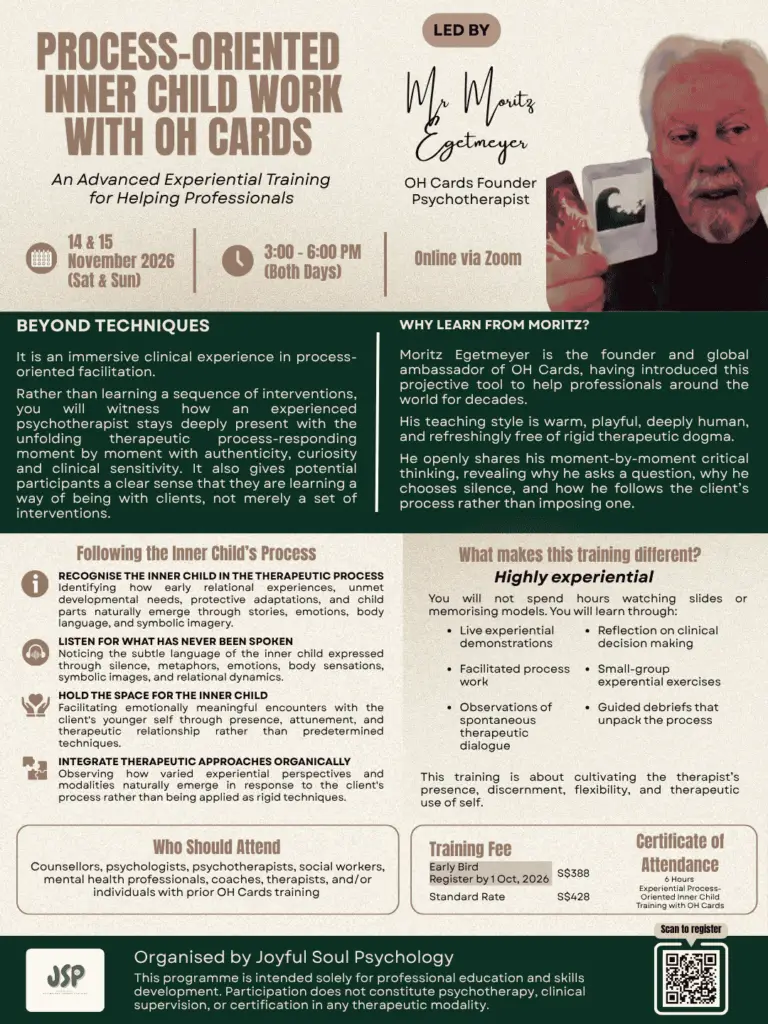
At our upcoming inner child works with OH Cards training hosted by Joyful Soul Psychology, we are bringing Moritz Egetmeyer, the global founder of the OH Cards modality, to teach us how to translate these psychological concepts into pure, non-directive coaching mastery.
Here is what we will walk away with to upgrade our professional toolkit:
- The Practical Framework: Step-by-step training on how to use associative cards to safely evoke deep awareness while keeping the session 100% client-led.
- The Safe Boundary Scripting: Live demonstrations on how to manage pacing, track physiological shifts, and smoothly transition back to future-focused actions if a client encounters uncomfortable reflections.
- Business ROI: A unique, highly visible tool that immediately differentiates our coaching practice in the corporate, executive, or personal development niches.
- Credential Security: Learn the exact parameters, and we, ourself, can take ownership to make ensure that our deep-work sessions are within the ICF performance evaluation and competencies.
Direct Comparison: Deep Coaching Work vs. Clinical Therapy
| Feature | ICF Coaching Scope | Therapy / Clinical Scope |
| Primary Goal | Self-awareness, self-empathy, and behavioral change. | Resolving developmental trauma and healing clinical wounds. |
| Temporal Focus | Present awareness to unlock future potential. | Past historical exploration to treat root causes. |
| The Core Resource | Tapping into innate curiosity, playfulness, and joy. | Processing historic pain, deficits, and dysregulation. |
| Interpretation | 100% Client-Led. The client defines the metaphor. | Practitioner-guided analysis and diagnostic labeling. |
The Ethical Pivot: Knowing When to Refer Out
Once your client is fully grounded and emotionally regulated, we must evaluate the session boundaries. Under ICF Ethical Standard 18, we must suggest a referral if the client is better served by another professional.
The Solution: Why OH Cards Pass the ICF Audit Naturally
When we want to access the subconscious safely without relying on heavy guided visualisations that analytical clients possibly resist, OH Cards offer the natural clinical workaround.
Engineered around absolute client autonomy, the foundational rule of the OH Card methodology states: The cardholder is the sole interpreter of the image. The coach is strictly forbidden from interpreting, diagnosing, or correcting the client’s perception.
In addition, looking at a physical, external card provides immediate projective distance. Because the imagery sits on the table outside of the client’s mind, it acts as a visual buffer. This psychological safety prevents sudden nervous system flooding, stops the inner critic from hijacking the session, and naturally invites the client’s free-spirited, curious inner child to lead the way toward their coaching goals safely.
Give Your Practice a Master-Level Upgrade
Let’s not guess our way through the delicate boundaries of deep coaching or based it on the opinions of others. Rather, take ownership to establish absolute ethical confidence in our practice.
Join us at Joyful Soul Psychology for an exclusive upcoming workshop featuring Moritz Egetmeyer, the founder of the OH Cards modality. Learn firsthand how to use this non-directive canvas to evoke profound awareness, manage nervous system pacing, and catalyse sustainable growth for our clients.
Register for the upcoming inner child work with OH Cards training by Mr Moritz = https://forms.gle/pTnyQztjYkRQzSd67
Email us jsp.wyeo@gmail.com or WhatsApp +65 8835 3015; Check out JSP IG = https://www.instagram.com/p/DQCC3_DAs1j