
Community routines are predictable, when we teach the steps.
Worksheets don’t work at the Hawker Centre: Shifting from theory to real-world execution.
Many neurodivergent young adults know social rules in theory. They can recite scripts perfectly at home. Yet, step into a crowded Hawker Centre? They freeze. Enter a busy MRT station? They withdraw.
It is not a lack of intelligence. It is a breakdown in real-time cognitive generalisation. Traditional social skills groups teach the what. They fail to build structural anchors for the where.
At Joyful Soul Psychology, we bridge this gap by bringing the gold-standard, evidence-based PBIS (Positive Behavioral Interventions and Supports) framework out of schools, pairing it with clinically rigorous Child-Directed Interaction (CDI) and Verbal-Directed Interaction (VDI) techniques, and applying them directly within the Singapore community.
The Hidden Sensory Tax of Public Spaces
In a quiet clinic room, buying groceries is simple. But the real world has no pause button. A standard neighborhood supermarket presents intense sensory friction:
- Flickering fluorescent lights.
- Rattling shopping trolleys.
- Loud, unpredictable queues.
For a highly anxious brain or an individual with ADHD/ ASD, this data may flood their working memory. When working memory overloads, executive functioning goes completely offline. The brain cannot retrieve a social script; it is too busy managing environmental noise.
When anxiety spikes, an avoidant freeze state takes over, and verbal responding drops to zero. If adults step in to rescue them by speaking on their behalf, we practice “mind-reading”, or facilitated communication. This unintentionally reinforces and lengthens the avoidance cycle. To build true autonomy, we must use clinical communication loops to bridge anxiety and trigger “Brave Talking”.
The PBIS Approach: Systems, Data, and Practices
According to the Center on PBIS, effective behavioural interventions require three deeply integrated pillars to improve outcomes:
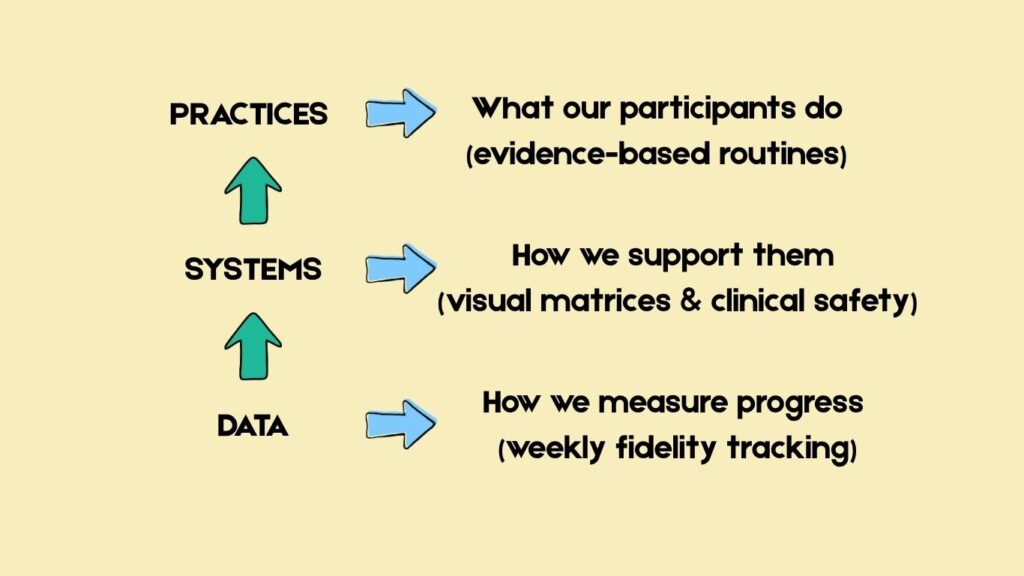
Our program uses these three pillars to turn unpredictable public settings into predictable, manageable routines. Building on our previous framework, our small-group cohorts master four essential life loops, for example:
1. The Hawker Centre Script (Practices)
- The Routine: Approach ➔ Ask ➔ Confirm ➔ Pay.
- The Skill: Regulating speech volume against noisy backgrounds.
- The Fix: Managing order errors or changes calmly.
2. Supermarket Problem-Solving (Practices)
- The Routine: Locate items ➔ Check out ➔ Verify receipts.
- The Skill: Finding alternative solutions when items are out of stock.
- The Fix: Asking a retail employee for help politely.
3. Transit and Commute Etiquette (Practices)
- The Routine: Boarding ➔ Traveling ➔ Alighting.
- The Skill: Navigating active, busy MRT junctions safely.
- The Fix: Managing physical personal space in tight crowds.
4. Public Eating Manners (Practices)
- The Routine: Dining ➔ Clearing ➔ Hygiene.
- The Skill: Ordering an item with specific dietary preferences or modifications.
- The Fix: Asking a server politely for missing utensils or napkins.
The Micro-Clinical Engine: Pairing CDI & VDI
Tier 1: Child-Directed Interaction (CDI) Skills
Before demanding speech, we establish a zero-pressure, warm environment using CDI PRIDE skills. We use Behavioral Descriptions (narrating their actions) and Reflections (repeating what they do say). Crucially, we avoid mind-reading. If they point silently to an item, we do not say, “Oh, you want the red one.” Doing so removes their reason to speak. Instead, we sit with the space and prepare for a verbal launch sequence.
Tier 2: Verbal-Directed Interaction (VDI) Skills
When it is time to prompt for speech, we initiate the formal VDI Sequence: Direct-Forced Choice Question ➔ 5-to-10 Second Wait ➔ Reflection + Labeled Praise for Talking. We avoid open-ended questions like “What do you want?”, which paralyze an overloaded brain.
What if they try to point, nod, or stay silent?
Clinical protocols dictate that we never accept non-verbal avoidance once a verbal loop is initiated. If you accept a nod, the brain learns that freezing avoids the stress of speaking.
If they do not vocalise within a full 5-to-10 second count, immediately break down the speech target into a Vocal Breakdown Prompt. Here is exactly how to execute this across our 4 community loops:
At the Hawker Stall
- Step 1 (Forced Choice): “Are you getting the chicken rice or the fishball noodles?”
- Wait 5–10 Seconds. (The individual points to the chicken rice sign or stays silent).
- The Vocal Breakdown Prompt: Acknowledge the presence of the choice but require a spoken sound. Say: “I see you pointing to the chicken. Tell me just one word: ‘chicken’ or ‘noodles’? Say it for me.” If they still freeze, use a phonemic cue: “Say ‘ch…’ [pause] ‘chicken’.”
- The Vocal Success Praise: The moment they vocalise even a single syllable, Reflect and Praise: “You said chicken! Fantastic job using your brave voice to say that out loud!”
In the Supermarket Aisle
- Step 1 (Forced Choice): “Should we look for the staff in the red or the blue uniform to help us?”
- Wait 5–10 Seconds. (The individual shrugs or stays silent).
- The Vocal Breakdown Prompt: Reduce the cognitive load to a single-word vocal mimicry prompt. Say: “Let’s ask for help. Repeat after me: ‘Help’.” Or give a highly structured binary vocal choice: “Say the color: ‘Red’ or ‘Blue’.”
- The Vocal Success Praise: The moment they speak the word: “Excellent! You said ‘red’. Let’s walk over to him together.”
Navigating the MRT Station
- Step 1 (Forced Choice): “Are we following the green line for Tanjong Pagar Station, or the yellow line?”
- Wait 5–10 Seconds. (Child stares at the sign silently).
- The Vocal Breakdown Prompt: Simplify the speech target down to a single color word. Tap their pocket map and say: “Is the line we need green or yellow? Tell me the colour.” If they remain silent, prompt: “Say ‘green’.”
- The Vocal Success Praise: The moment they vocalise the colour: “Awesome tracking! You said ‘green’. Let’s follow those green arrows.”
At a Café Table
- Step 1 (Forced Choice): “Will you ask the server for a fork or a spoon?”
- Wait 5–10 Seconds. (Child points to your fork or stays frozen).
- The Vocal Breakdown Prompt: Scaffold the verbal request with a low-coercion vocal mimicry target. Say: “I see you pointing. Let’s say the word together. Repeat after me: ‘Fork’.” Or: “I say first ‘fork’, your turn to say it.”
- The Vocal Success Praise: The moment they vocalise the word: “Wonderful job vocalising ‘fork’ clearly! You advocated for yourself using your own voice.”
Moving From Clinical Safety to Real-World Victory
True confidence does not grow in a quiet room. It builds on concrete, real-world execution.
Our small-group cohorts are tightly capped at 5 participants. Guided by a speech therapist and a psychologist, we use a structured, fading-support approach to gradually shift from intense VDI vocal prompting to totally unprompted, independent success:
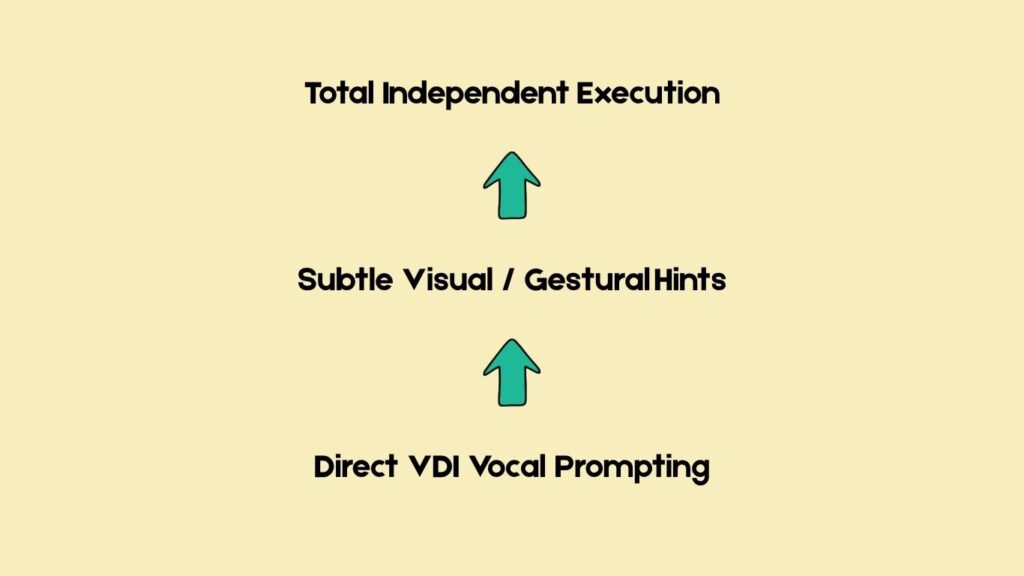
We do not guess progress. Aligned with official PBIS standards, we track data every single week. We measure prompt levels, independent spoken attempts, and situational fidelity. Parents receive objective progress updates showing exactly how their young adult is generalizing their verbal confidence into the real world.
Secure a Cohort Placement
Give your young adult the practical skills and verbal strategies they need to navigate Singapore safely, confidently, and autonomously.
Our upcoming PBIS-based Community Skills Programme.
Spaces are strictly limited to ensure safety and dedicated clinical attention.
WhatsApp Us: +65 8835 3015
Email Our Intake Team: contact@joyfulsoulpsychology.com

