
Turning Internal Chaos and ADHD Overwhelm into Actionable Data
We often treat anxiety like an uninvited intruder. And for the neurodivergent brain, it feels less like an intruder and more like a permanent roommate.
Whether you are navigating typical life stressors or managing a brain wired for ADHD, anxiety is rarely just “worried thoughts.” It is intimately tangled up with executive dysfunction, sensory overload, and a nervous system that struggles to find a baseline. It arrives with a racing heart, a tight chest, and an intense spinning mind, screaming at us to shut down, run away, or freeze.
But what if anxiety isn’t a system failure? What if it is a highly sophisticated, albeit noisy, data delivery system?
When we change our relationship with anxiety, i.e. shifting from deactivation to curiosity, we unlock the ability to build deeper connections with ourselves and the people we love. Below, we break down how to reframe anxiety, unpack the hidden data behind your heaviest emotions, and use exact emotional labels to regain control and break out of paralysis.
The Dual Lens: What Anxiety Feels Like Across the Kitchen Table
Anxiety rarely happens in a vacuum. It ripples through families, often creating a painful disconnect between what a young adult is experiencing and what a parent is witnessing.
The Young Adult’s Lens: “I’m Stuck in Paralysis, Not Being Lazy”
“When my anxiety hits, it blends with my sensory system and executive functions. My brain tries to process a million uncertainties and tasks at once, and it completely jams. I am staring at my laptop or my room, totally frozen, experiencing intense internal panic because I don’t know where to start. When my parents ask me ‘What’s wrong?’ or tell me to ‘Just do it,’ it feels like a demand I don’t have the neurological resources to meet. I’m not trying to be difficult or avoidant. I am genuinely flooded, and I don’t know how to sort through the noise yet.”
The Parent’s Lens: “I Just Want to Fix Their Lack of Momentum”
“Watching my child spiral, stay stuck, or lock themselves away triggers my own panic about their future. My instinct is to swoop in, nudge, or give logical advice to make the discomfort go away and get them moving. But I’ve realized that my urgent need to ‘fix it’ looks like nagging and actually overrides my ability to listen. I want to learn how to tolerate my own discomfort so I can be a steady anchor for them, instead of feeding into their storm.”
Anxiety is Data: Discovering What Your Brain Truly Cares About
Unpleasant emotions are completely legitimate. There is nothing inherently wrong with feeling anxious, panicked, or uneasy. To start deactivating the threat response, we must look directly at the monster.
Try This Exercise Right Now:
Take out a piece of paper or open a blank notes page on your phone. List every single thing you are currently anxious about. Don’t filter it. Write down the big career moves, the unreturned messages, the clutter on your desk, and the fear of missing deadlines.
Now, look at that list and ask yourself: What do all of these things have in common?
The answer is simple, yet profound: They are all things you care about in your life.
Why would anxiety be a bad thing when it is simply a siren telling us that something might not be going right with the things we value most? If you didn’t care about your future, your autonomy, or your relationships, you wouldn’t feel anxious about them. For an individual with ADHD, anxiety is also frequently the brain’s clumsy way of trying to generate the urgency (adrenaline) needed to focus when dopamine is low. Anxiety isn’t proof that you are broken; it is an opportunity to look deeper into what matters to you.
Emotional Precision: Breaking the “Vague Overwhelm” Loop
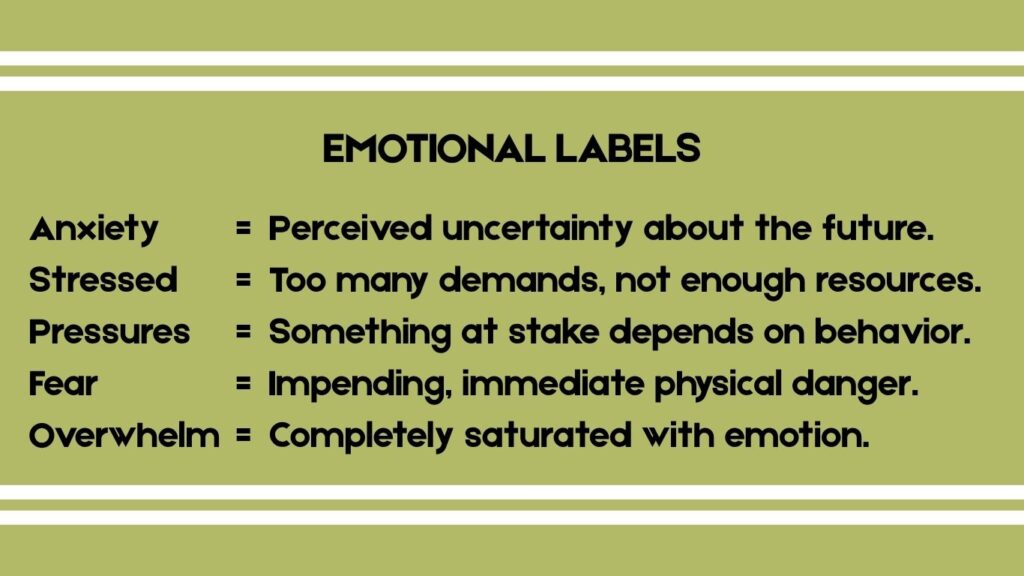
When you are overwhelmed or live with ADHD, a major challenge is alexithymia, difficulty identifying and naming exact emotions. When we don’t know exactly what we are feeling, we have no idea what action step to take next. We default to vague terms like “stressed” or “overwhelmed,” which leaves us paralysed.
Precision in emotional labels is a masterkey for neural regulation. By accurately naming the emotion, you shift processing from the reactive, emotional centers of the brain (the amygdala) to the analytical centers (the prefrontal cortex).
Let’s look at the exact definitions of five distinct emotional states that are often lumped under the generic umbrella of “anxiety”:
The Danger of Mislabeling
Sometimes, our brains misinterpret complex interpersonal emotions because other labels feel safer or more familiar. For example, you might tell yourself you feel sad, stressed, bored, or tired, when the underlying raw emotion is actually envy or rejection sensitivity.
If you treat envy with a nap because you think you’re tired, the feeling won’t change. But if you identify it accurately as envy, you know the precise antidote is gratitude and celebrating someone else’s success to reframe your own goals.
Three Functional, Neuro-Affirming Strategies to Try Today
Here are three practical tools built to help both neurotypical and ADHD nervous systems handle high-anxiety moments:
1. Observe, Don’t Absorb: The Picture Frame Visualization
Negative energy from chaotic environments or well-meaning but anxious parents can easily flood a sensitive sensory system. To create space between yourself and the emotion, use a visual boundary.
- Imagine a beautiful, thick picture frame sitting between you and the situation.
- Place the anxious thoughts, the chaotic environment, or the other person’s frantic energy inside that frame.
- Remind yourself: “I can look at this picture, I can study it, and I can understand it, but I do not have to step inside it. I am the observer, not the ecosystem.”
2. Temporal Distancing for the “Now vs. Not Now” Mind
The ADHD brain struggles with time perception, making the present moment feel permanent. When anxiety strikes, your brain thinks, “I feel this way right now, which means I will feel this way forever.” Break this illusion by shifting your timeline. Ask yourself:
- How am I going to feel about this specific issue in one week?
- How will I feel about it in one month?
- How much will this matter in one year?
This cognitive shift pulls your brain out of the immediate fight-or-flight loop and reminds you of a fundamental truth: This feeling is temporary. It rains, it shines, it passes.
3. Somatic Containment Before Cognitive Reframing
If your body is trapped in a high-alert state or sensory overload, no amount of positive thinking will work. You must calm the nervous system first before you can get curious.
- For Young Adults: Use a cold stimulus (like a cold water splash or holding an ice cube) to stimulate the vagus nerve and down-regulate panic instantly. Alternatively, engage in “heavy work” (like pushing against a wall or stretching) to give your joints proprioceptive feedback, which anchors a spinning mind.
- For Parents: Stop talking, stop giving reminders or solutions, and instead lower your vocal pitch, slow your breathing rate, and offer a quiet, grounded presence. Co-regulation must always precede communication.
Move From Understanding to Transformation
Reframing your internal world requires consistent practice, the right frameworks, and concrete tools that respect how your unique brain operates. Download a digital resource designed to help you bridge the gap between feeling stuck and taking confident action.
Resources
- The Emotional Precision & Neuro-Affirming Regulation Toolkit
Stop guessing what your body needs. This digital info sheet includes advanced emotional-tracking matrices tailored for neurodivergent and neurotypical individuals, linguistic deep-dives to isolate hidden triggers, and step-by-step somatic blueprints to break out of paralysis and handle sensory overwhelm. i.e. Break out of paralysis, track hidden triggers, and master somatic containment tools. - The Co-Regulation Playbook: A Parent’s Guide to Anxious Moments
Change the dynamic across the kitchen table. Learn the exact communication scripts, behavioural boundaries, and somatic grounding tools needed to support your ADHD or anxious young adult through emotional dysregulation without enabling avoidance or escalating friction. i.e. Get the exact communication scripts and behavioural boundaries to text and talk your young adult through intense sensory overwhelm.
We always retain the power to choose how we respond to our emotions. Let’s stop fighting your anxiety and start decoding what it wants to tell you. Take the first step toward a collaborative, supportive partnership today. Contact us: What’sApp +65 8835 3015 / Email contact@joyfulsoulpsychology.com / IG https://www.instagram.com/joyfulsoulpsychology/ / JSP Supports https://joyfulsoulpsychology.com/services/
Reference
This blog is inspired and adapted from Mel Robbins’ interview with Dr. Marc Brackett, How to Master Your Emotions & Never Get Angry or Bothered by Anyone

