Beyond Tarot: The iNUK Cards and the Art of Self-Discovery
At the heart of many coaching and therapeutic journeys is the question: Who am I? iNUK cards are crafted to invite that question. Their artwork reflects inner states, life situations and emotional processes related to identity and personal path. Rather than supplying answers, iNUK provides evocative images that prompt memory, metaphor and new perspectives. A gentle surface where hidden stories can appear, playfully.
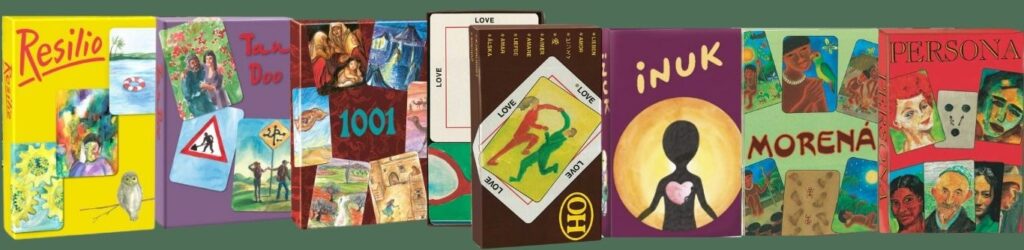
This guide explains what iNUK is, how it differs from other OH-Cards series, and practical ways to use INUK for solo reflection and professional practice.
iNUK in one line
iNUK helps you explore the question “Who am I?” by surfacing moods, life moments and emotional patterns through richly symbolic imagery.
This unique round shape card encourages users to rotate the card to view the image from different angles, which can alter its interpretation and offer new perspectives. The iNUK set includes 10 transparent, hollowed-out cards. These can be placed over a picture card to act as a “magnifying glass” or “window,” revealing only a portion of the main image. This technique helps focus attention on a specific detail or creates a new narrative from a limited view.
How iNUK differs from other OH-Cards series
All OH-Cards invite projection and associative meaning, but each series emphasises a different theme:
- Original OH Cards — broad, versatile starter deck for free association wich features everyday situations, and comes with word cards.
- Persona / Personita — portrait decks emphasising roles, masks and younger selves, with interaction cards.
- Resilio / Cope — resilience and coping themes (stress, recovery, resources), with animal cards.
- TanDoo — relationship dynamics and couple-focused prompts.
- iNUK — focused on existential identity: inner moods, life situations, emotional processes and the question “Who am I?”
What sets iNUK apart: its imagery tends to pull attention inward, e.g. to feelings, life transitions, identity questions and the emotional textures of being. Use iNUK when the goal is to deepen self-understanding, clarify life direction, or explore how emotional patterns shape choices.
Core benefits of iNUK
- Reveals implicit identity narratives without direct questioning.
- Makes emotional processes visible and discussable.
- Supports self-compassion by externalising internal states into image and story.
- Helps translate metaphor into practical, identity-aligned action.
Safe practice notes
iNUK can access sensitive material. Grief, identity wounds, migration or cultural dislocation may surface. Always:
- Get consent for deep exploration.
- Offer grounding tools (PQ reps) and a signal to pause.
- Use culturally humble language and avoid assumptions.
- Refer to specialist therapy if trauma or overwhelming distress appears.
Practical iNUK exercises
Solo Draw — “Who am I, today?”
- Intention: curiosity about current identity and mood.
- Steps: Take mindful breathe 30s, shuffle iNUK, draw one card. Describe literal details (2–3 min), then free-write for 7–10 minutes on the prompt: “This image suggests I am…” Close by naming one small action to honour the insight.
Three-Moment Map — “My life in three scenes”
- Intention: identify recurring emotional patterns across time.
- Steps: select three INUK cards to represent past, present, future (or childhood, turning point, now). For each: note the felt emotion, a memory or scene it evokes, and a resource or need. Synthesise into one sentence about your throughs and choose one experiment to support the future you want.
Inner-State Resource
- Intention: transform a felt state into a practical support.
- Steps: draw one card. Ask: “If this inner state could offer me a resource, what would it be?” List 2–3 actionable ways to use that resource this week (e.g., a small ritual, a question to ask yourself, a boundary).
Practical prompts & thinking questions
OH Cards and its series are highly flexible The suggested “Why it’s useful”, “Possible Use” and “Try this” activities are provided as illustrative examples to support exploration, and are not exhaustive. They do not limit how any deck of the OH Cards may be used. OH Cards users are encouraged to adapt, experiment (e.g. combine series, create their own prompts), and apply the cards in ways that best match their aims, cultural context, curiosity, and professional judgement.
Combining decks
Like all OH Card series decks, iNUK cards are designed to be used in conjunction with others. For example, placing an iNUK picture card inside an OH word card can lead to new combinations and insights. This modularity allows users to combine different themes, expanding the possibilities for storytelling, reflection, and therapy.
Three quick exercises to try right now
- Solo micro-explore (5 min): Shuffle one series, pull one card, journal for 3 minutes on the first image-word that appears.
- Pair-swap (10 min): Each person selects a card from TanDoo or Persona, tells the story in 60 seconds; partner reflects back one key emotion they heard.
- Resource triplet (15 min): Using Resilio, choose three cards that represent resources you already have, then plan one action to activate each resource within the week.
Why exploring series matters
Different series act like different lenses: sometimes we need story (1001), sometimes we need cultural or environmental context (INUK, Habitat), sometimes identity or inner-child focus (Persona, Personita), and sometimes an explicit resilience lens (Resilio, Cope). Experimenting across these series expands the metaphoric vocabulary we and our clients can deploy, and metaphors open doors that direct questions often cannot.
Stuck in words? Try images. Which OH Cards series will unlock your next breakthrough?
Curious to try?
If you want hands-on exploration, join our upcoming OH Cards workshop or register for the upcoming OH Cards training workshop facilitated by the OH Cards creator, Mr Moritz Egetmeyer! We work with multiple series and practice reflective prompts, pair exercises and micro-interventions.

