
Which OH Cards deck will surprise you? Explore INUK, Cope, TanDoo, Resilio, Habitat, Persona and Personita…
Metaphor has a way of revealing what words cannot. The OH Cards family offers a range of thoughtfully themed decks, each with its own visual language and reflective purpose. Whether we’re a coach, therapist, facilitator or curious individual, choosing the right series helps us tailor questions, deepen insight, and invite unexpected breakthroughs.
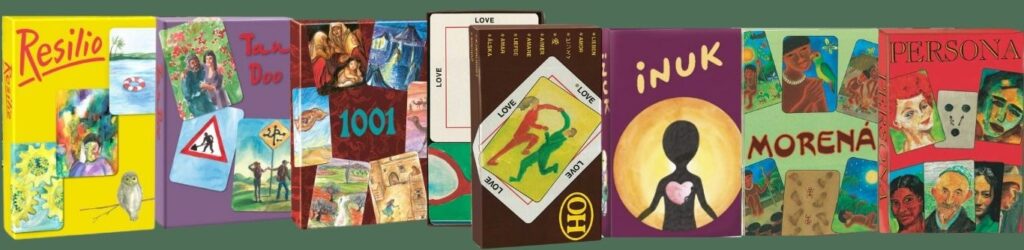
Below are some practical introductions to eight OH Cards series and quick ideas for how to use each one in therapy, coaching, group work or personal reflection.
OH Cards — Base set
Why it’s useful: The original OH Cards deck is versatile and open-ended, a foundational deck designed to stimulate imagination, free association and conversation.
Possible Use: Warm-ups, general self-discovery, exploratory reflection and icebreakers.
Something to try: Choose a picture card and a single word card, use the pair as a doorway to story and metaphor: “What does this image + word invite me to notice?”
iNUK — Culture, Place & Belonging
Why it’s useful: Inuk invites reflection through imagery that evokes landscape, culture and relational context. Some find it excellent for exploring identity, roots, and belonging with its existential question, “Who am I, what makes me how I am?”.
Possible Use: Identity work, cultural reflection, legacy conversations and team values exercises.
Something to try: Use Inuk when exploring questions like “What does a meaningful and fulfilling life look like for me, independent of others’ expectations?” or “What are my core values? Do my daily actions reflect these values, or do I compromise them?”
Cope — Navigating Stress & Change
Why it’s useful: Cope is geared toward resilience and coping-focused reflection. The imagery helps clients externalise stress patterns and imagine practical responses.
Possible Use: Burnout conversations, resilience coaching, transition support and stress mapping.
Something to try: After drawing a card, ask: “What is this image showing about how I cope? What small shift might ease that pattern?”
TanDoo — Relationship & Couple Work
Why it’s useful: TanDoo supports relational exploration. Its imagery is crafted to speak to dynamics between people — roles, needs, conflicts and tenderness.
Possible Use: Couple sessions, team dynamics, communication exercises and empathy practices.
Something to try: Select a card to represent how you feel in a relationship; then draw a card and reflect from the other person’s perspective.
Resilio — Stress, Recovery & Resilience
Why it’s useful: Resilio focuses on stress, resources and recovery. Use it to balance problem-focused work with resource discovery, who/ what helps us rebuild.
Possible Use: Resilience planning, recovery pathways, and identifying personal resources.
Something to try: Draw a card to name a resource you already have; write one practical way to activate it this week.
Habitat — Nature, Context & Environment
Why it’s useful: Habitat draws on nature and environment metaphors. It’s ideal when we want to connect with our inner experience to outer context — place, rhythms and ecosystems. It stimulate questions about the interconnectedness of all things.
Possible Use: Nature-based coaching, grounding practices, values linked to environment and sustainable change planning.
Something to try: Use Habitat cards in a grounding sequence: draw, note one sensory image, and create a 60-second practice inspired by that image.
Persona — Adult Identity & Roles
Why it’s useful: Persona features portraits and adult personae that make identity, roles and social masks visible. It’s especially useful for role clarity and career conversations.
Possible Use: Career pivoting, leadership identity, role conflict and interpersonal patterning.
Something to try: Pick a Persona card to represent your public role, then ask: “What does this role ask of me? What does it cost?”
Personita — Youthful Perspective & Development
Why it’s useful: Persona features portraits and adult personae that make identity, roles and social masks visible. It’s especially useful for role clarity and career conversations.
Possible Use: Career pivoting, leadership identity, role conflict and interpersonal patterning.
Something to try: Pick a Persona card to represent your public role, then ask: “What does this role ask of me? What does it cost?”
Disclaimer
OH Cards and its series are highly flexible The suggested “Why it’s useful”, “Possible Use” and “Try this” activities are provided as illustrative examples to support exploration, and are not exhaustive. They do not limit how any deck of the OH Cards may be used. OH Cards users are encouraged to adapt, experiment (e.g. combine series, create their own prompts), and apply the cards in ways that best match their aims, cultural context, curiosity, and professional judgement.
How to pick which deck to use
- Match the deck to the intention. (Resilio for resilience, TanDoo for relationships.)
- Consider visual tone. Some decks feel spare and open; others are culturally specific or narrative. Choose the tone that invites curiosity for your audience.
- Combine with purpose. Start with OH Cards (original) to warm up; then deepen with a themed deck (Persona, Resilio or TanDoo).
- Let choice tell us something. Invitation to pick which deck we’re drawn to can itself be diagnostic.
Three quick exercises to try right now
- Solo micro-explore (5 min): Shuffle one series, pull one card, journal for 3 minutes on the first image-word that appears.
- Pair-swap (10 min): Each person selects a card from TanDoo or Persona, tells the story in 60 seconds; partner reflects back one key emotion they heard.
- Resource triplet (15 min): Using Resilio, choose three cards that represent resources you already have, then plan one action to activate each resource within the week.
Why exploring series matters
Different series act like different lenses: sometimes we need story (1001), sometimes we need cultural or environmental context (INUK, Habitat), sometimes identity or inner-child focus (Persona, Personita), and sometimes an explicit resilience lens (Resilio, Cope). Experimenting across these series expands the metaphoric vocabulary we and our clients can deploy, and metaphors open doors that direct questions often cannot.
Stuck in words? Try images. Which OH Cards series will unlock your next breakthrough?
Curious to try?
If you want hands-on exploration, join our upcoming OH Cards workshop or register for the upcoming OH Cards training workshop facilitated by the OH Cards creator, Mr Moritz Egetmeyer! We work with multiple series and practice reflective prompts, pair exercises and micro-interventions.

