
Key Takeaways (In a Nutshell)
They are tools, not synonyms: Our inner child holds unmet needs; reparenting provides compassionate adult care; growth mindset builds new habits forward.
Healing requires taking responsibility for ourselves: Understanding our past explains our triggers, but owning our choices today creates real change.
Beware over-self-absorption and relentless optimisation: True growth moves us outward toward connection, intention, and committing to what genuinely matters.
Start where you are: Stabilise immediate daily triggers first before diving into deeper core beliefs and cultivating healthy pride.
If you have spent any time on mental health blogs or personal development podcasts lately, you have likely seen inner child healing, reparenting, and growth mindset used almost interchangeably. At first glance, they all point toward becoming a healthier, more resilient version of yourself.
Yet we hear about or when we try ourselves, often we feel stuck precisely because these three concepts get blurred together. We might try to use “growth mindset” affirmations to push past deep childhood grief, only to feel like a failure when their nervous system shuts down. Or we might spend years analysing their “inner child” without taking ownership of how they show up in their career or relationships today.
Understanding how these three concepts differ, and how to sequence them safely with personal accountability, can transform the way we heal, communicate, and grow.
Breaking Down the Three Concepts: Same Goal, Different Jobs
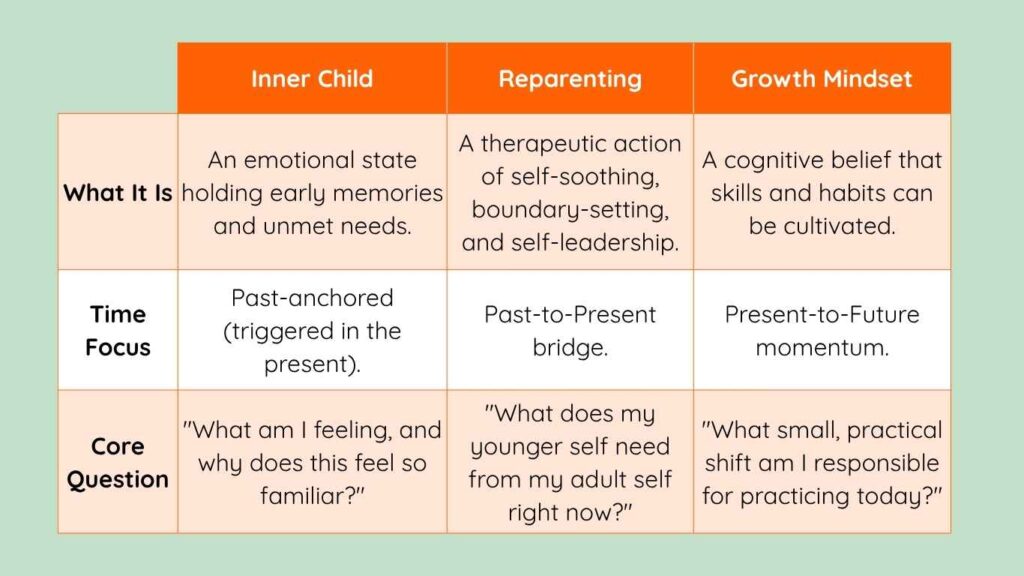
To use these frameworks effectively, it helps to separate who is hurting, how we care for them, and what moves us forward.
The Inner Child: The Part That Remembers
In psychology, the inner child is not a literal person inside us; it is a way of describing early emotional memories, attachment patterns, and survival adaptations formed when we were young. When a minor comment from a boss or partner triggers an overwhelming wave of shame, panic, or defensiveness today, it is often our inner child reacting to an old, familiar wound.
Reparenting: The Compassionate Adult Response
If the inner child is the part that holds the pain, reparenting is the active process of our present-day adult self stepping in to take responsibility for providing the safety, validation, and boundaries that were missing back then. Inspired by structured reflective frameworks, i.e. reparenting happens when we pause, separate our adult self from the triggered younger part, and offer a grounded, nurturing inner dialogue instead of harsh self-criticism.
Growth Mindset: The Engine of Forward Change
Coined by psychologist Carol Dweck, a growth mindset is the belief that your abilities, emotional regulation, and resilience are not fixed traits—they can be developed through effort, learning, and strategy. While inner child work looks backward to understand a wound and reparenting bridges past to present to soothe it, a growth mindset looks forward, empowering you to practice new responses through daily micro-corrections.
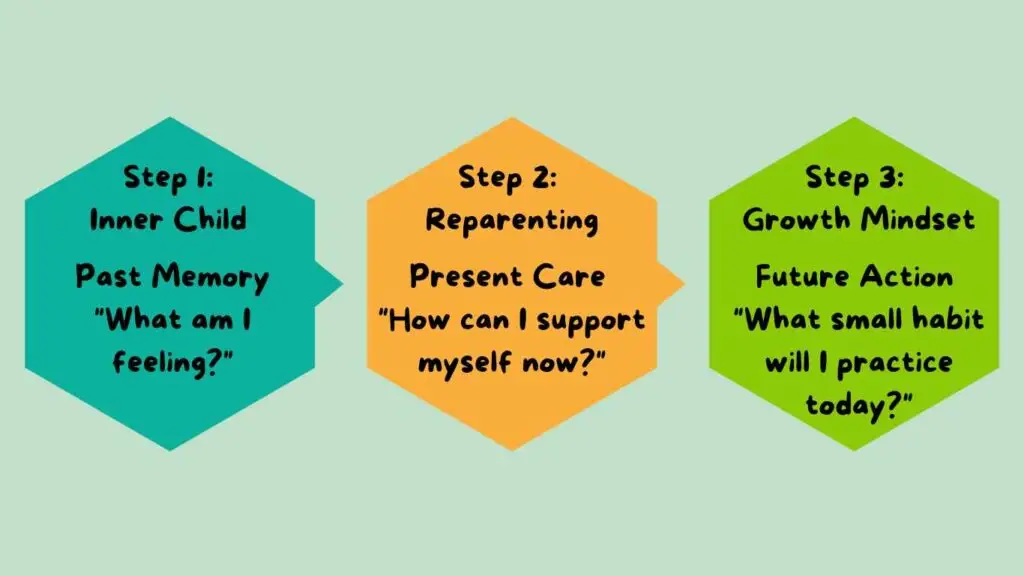
to practicing daily adult responsibility.
A Necessary Caution: Self-Responsibility vs. Over-Self-Absorption
Self-reflection is essential for healing, but there is a fine line between purposeful introspection and over-self-absorption.
When inner child work becomes an endless loop of dissecting every past slight, monitoring every micro-emotion, or relentlessly trying to “optimise” ourself, it stops being therapeutic. Psychologically, excessive inward focus turns into rumination, which amplifies anxiety, stalls personal agency, and isolates us from others.
True reparenting is fundamentally an act of radical self-responsibility. While you are not to blame for what happened to you as a child, as an adult, you are responsible for how you regulate your emotions, communicate your needs, and live your life today. In practice, healthy self-responsibility anchors our healing in four outward-facing choices:
- Purposeful Introspection: Examining our feelings, anxieties, and desires not to endlessly diagnose ourself, but to understand what genuinely brings us peace and joy.
- Deliberate Intention: Taking ownership of our decisions so we can actively resolve sources of distress and savour what truly matters.
- Balanced Connection: Prioritising close friendships and meaningful relationships while maintaining healthy self-care boundaries, i.e. showing up with genuine warmth and attuned communication without over-giving or losing yourself to please others.
- Focused Commitment: Choosing to commit wholeheartedly to a few meaningful values and relationships rather than chasing endless options or exhausting ourself through relentless self-optimisation.

i.e. honouring our own boundaries while building deep,
intentional relationships without over-extending.
Why We Start Where We Are: Immediate Issues First
A common misconception about therapy and coaching is that we must immediately dive into our deepest childhood memories on day one. In practice, doing too much too soon can overwhelm our nervous system. And this might also distract us from the practical decisions right in front of us.
At Joyful Soul Psychology, we believe in starting right where you are:
- Stabilize the immediate issue: Are you struggling with burnout at work, freezing up during difficult conversations, navigating neurodivergent sensory overload, or reacting defensively with your spouse? We focus first on discussing practical tools, drawing from evidence-based approaches like CBT, ACT, DBT, and speech and communication strategies, so you can take steady ownership of what is happening in your life this week.
- Build somatic and linguistic safety: Before engaging in deep inner dialogue, you need the grounded presence and emotional vocabulary to name what you feel without getting swept away by it.
- Practice daily micro-corrections: Using a growth mindset, you take responsibility for testing small, manageable changes in how you speak to yourself and communicate with others.
Going Deeper: Core Beliefs and Healthy Pride
Once our immediate daily stressors feel steadier and our adult self feels safely in the driver’s seat, we are ready to go deeper, if and when you choose to.
At this stage, deeper work focuses on uncovering and reshaping core beliefs, i.e. the quiet, underlying rules we may have carried for decades (such as “I am only worthy when I constantly optimise and achieve” or “My needs are a burden” ). We can gently bring unspoken truths into the light and consciously choose new, healthier beliefs to live by.
Just as importantly, deeper work is not only about healing pain; it is about cultivating healthy pride, i.e. a grounded, quiet confidence in who you are, flaws and all. Unlike arrogance, healthy pride strengthens our sense of self, deepens our capacity for connection, and anchors our commitment to a life that feels authentic. It allows us to say: “I recognise where I came from, I take responsibility for my choices today, and I know I am enough.”
Ready to Take Your Next Step at Your Own Pace?

Whether you are navigating immediate stress, working to quiet a relentless inner critic, or looking to build stronger communication and self-leadership, you do not have to figure it out alone.
At Joyful Soul Psychology, our team brings together Registered Counselling Psychology (Jovial Teo) and AHPC-Registered Speech Therapy & ICF Coaching (Wendy Yeo) in a safe, neurodiversity-affirming space in Singapore. Together, we tailor support to where you are right now:
- Psychotherapy & Counselling: Evidence-based support (CBT, ACT, DBT) to process emotional triggers, heal core beliefs, and build lasting resilience.
- Coaching: Forward-focused partnership to turn insight into personal accountability, growth-mindset habits, and confident action.
- OH Cards Mapping: A creative, intuitive way to surface blind spots and explore your inner world without pressure.
- Speech & Language Therapy: Practical, affirming strategies to strengthen your authentic voice and social communication.
Not sure which service fits you best? Book a free 15-minute phone consultation with us today to share what you are experiencing and explore how we can journey alongside you.
Frequently Asked Questions
1. Can I practice inner child reparenting on my own, or do I need a therapist?
You can begin simple reparenting habits on your own, i.e. such as pausing when triggered, naming your emotions, and practicing a kinder internal voice. However, if exploring past wounds brings up overwhelming anxiety, dissociation, or deeply rooted shame, working with a registered psychologist or trained therapist provides safe co-regulation and pacing so you do not get stuck in rumination.
2. How do OH Cards help with inner child and reparenting work?
OH Cards are projective associative cards combining evocative images and words. When traditional talk therapy feels too analytical or guarded, the imagery acts as a gentle mirror, i.e. allowing unspoken feelings, blind spots, and unmet needs to surface safely without judgment so your grounded adult self can respond with clarity and compassion.
3. Should I start with psychotherapy, coaching, or speech and communication support?
It depends on what you need most right now. If you are navigating emotional distress, anxiety, trauma triggers, or deep core beliefs, psychotherapy and counselling is the safest starting point. If your emotions feel steady and you want structured accountability to build growth-mindset habits, ICF coaching is a strong fit. And if expressing your boundaries or navigating social communication feels challenging, speech and language therapy bridges that gap.suit your schedule and comfort level. You can visit us in person at our welcoming, quiet space at 171 Tras Street (Union Building), just minutes from Tanjong Pagar MRT, or opt for secure online tele-therapy and coaching sessions from the comfort of your home or office.
What’sApp +65 8835 3015 / Email contact@joyfulsoulpsychology.com / IG https://www.instagram.com/joyfulsoulpsychology/ / JSP Supports https://joyfulsoulpsychology.com/services/

