
Key Takeaways (In a Nutshell)
It’s Wiring, Not Willpower: Struggling with interrupting, scattered storytelling, or zoning out in noisy spaces isn’t a character flaw. It’s how ADHD impacts our brain’s executive functioning and working memory.
Why Standard Advice Fails: Rigid productivity hacks rely on consistent dopamine and working memory, often leading neurodivergent brains to burnout rather than progress.
The Therapy + Coaching Advantage: Combining AHPC-registered Speech Therapy (which builds thought-organization and social communication skills) with ICF ADHD Coaching (which builds brain-friendly routines and intentional follow-through) turns insight into real-world action.
Quick Wins You Can Use Today: Start externalixing your working memory on paper, lead conversations with your “headline” first, and work alongside a “Focus Buddy” for overwhelming tasks.
Have you ever walked away from a work meeting in the CBD replaying everything you said, e.g. wishing you hadn’t interrupted your boss, or frustrated that your brilliant idea came out sounding disorganised? Or perhaps you watch your child struggle to explain a simple story at dinner, getting overwhelmed by big emotions when the right words won’t come out.
If this sounds familiar, take a deep breath. You are not lazy, rude, or broken.
Many individuals in Singapore live with undiagnosed or unsupported Attention-Deficit/Hyperactivity Disorder (ADHD). While most people associate ADHD with hyperactivity or losing keys, one of its biggest hidden impacts is on executive functioning and social communication.
When we bridge clinical speech-language strategies with practical, forward-moving coaching, magic happens. We stop fighting our brain and start building systems that actually stick.
The Hidden Link Between ADHD and Communication
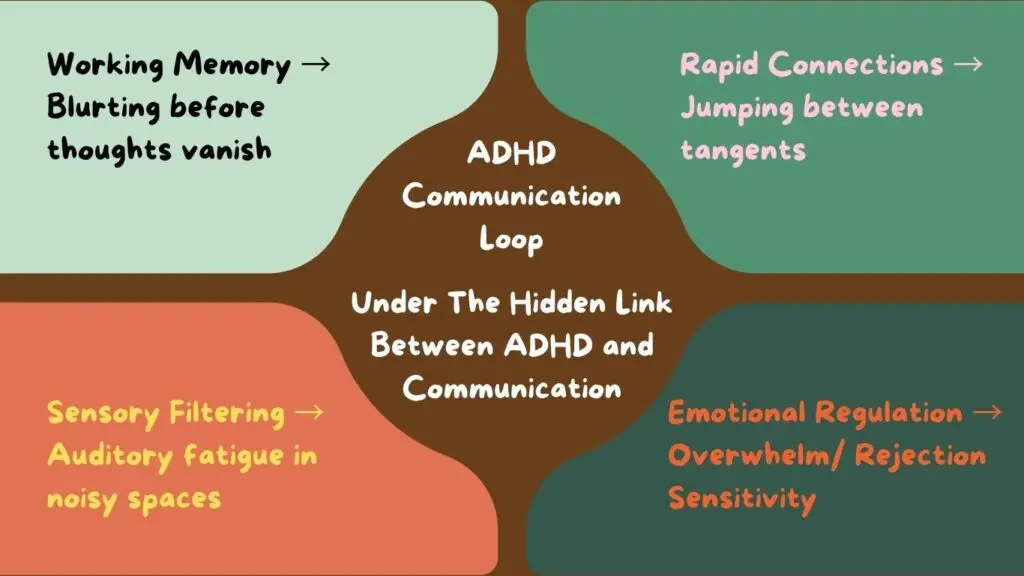
communication and working memory
To understand why ADHD affects how we speak, listen, and connect, we have to look at the brain’s management system: executive functioning. Think of executive functions as the air traffic controller of our mind. They regulate working memory, impulse control, emotional regulation, and cognitive flexibility.
When we have ADHD, that air traffic controller is working overtime without enough staff. Clinically, this shows up in our daily communication in several distinct ways:
- Pragmatic & Social Nuances: Reading subtle social cues, pacing our speech when excited, or navigating conflict without feeling intense Rejection Sensitive Dysphoria (RSD) can make relationships feel like walking through a minefield.
- Working Memory Bottlenecks: We have a great point to share in a discussion, so we blurt it out immediately. It’s not to be rude, but because we know if we wait 10 seconds, the thought will vanish completely.
- Narrative Disorganization: Because our brain makes rapid, creative connections, telling a linear story can feel impossible. We might jump from tangent to tangent, leaving listeners confused while we feel exhausted trying to get to the point.
- Auditory Processing Fatigue: In noisy environments (e.g. like a bustling hawker centre or an open-plan office) filtering out background noise to focus on one conversation takes immense cognitive energy. By 4:00 PM, our brain simply hits a wall.
Why Traditional Advice Fails Neurodivergent Brains
When we have are told to “just use a planner,””think before you speak,” or “try harder to pay attention”, we already know that neurotypical advice rarely works for an ADHD brain.
Standard productivity hacks rely on consistent dopamine and intact working memory, the exact things ADHD disrupts. Trying to force ourself into a rigid, neurotypical box only leads to shame, burnout, and masking.
At Joyful Soul Psychology, our philosophy is strictly neurodiversity-affirming, evidence-based, and client-centered. Joy isn’t about pretending everything is perfect or erasing our neurodivergence. It is about embracing who we are, understanding how our brain is wired, and equipping ourself with tools tailored to our unique strengths.
Speech Therapy vs. ADHD Coaching: How They Work Together
Wondering: Do I need a Speech Therapist, or do I need an ADHD Coach? The truth is, combining both creates a comprehensive roadmap from skill-building to real-world execution.
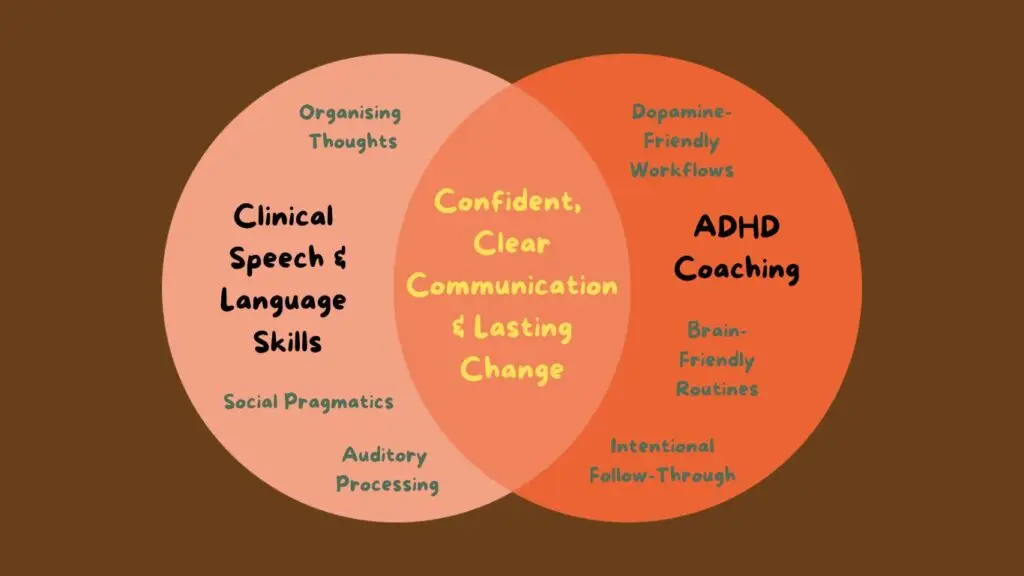
1. The Clinical Foundation: Speech & Language Therapy
Speech and language therapy isn’t just for articulation or early childhood speech delays. For children, teens, and adults with ADHD, clinical speech therapy targets the underlying cognitive-communication skills that make daily life smoother:
- Structuring Thoughts: Learning concrete frameworks to organise verbal and written ideas clearly. These skills are essential for school presentations, workplace emails, and difficult conversations.
- Social Communication & Pragmatics: Practicing conversational turn-taking, active listening strategies, and self-advocacy in a safe, judgment-free environment.
- Cognitive-Communication Strategies: Developing external memory aids and auditory comprehension techniques to reduce mental fatigue.
2. The Action Engine: ICF-Accredited ADHD Coaching
While therapy helps build foundational skills and process past challenges, coaching is a forward-focused, creative partnership. As an ICF-certified coach, its not a lecture or handing a one-size-fits-all checklist. Instead, we collaborate to:
- Build Self-Compassion & Resilience: By harnessing neuroplasticity (i.e. our brain’s natural ability to rewire and adapt) we replace years of negative self-talk with sustainable confidence.
- Bridge the “Knowing-Doing” Gap: You probably already know what you need to do; ADHD makes it hard to start. We design dopamine-friendly workflows, brain-friendly routines, and intentional follow-through strategies that spark action without shame.
- Navigate Career & Life Transitions: Whether you are a student struggling with exam prep or a working professional aiming for a promotion, we align your daily habits with your core values.
(Note: For individuals navigating deeper emotional wounds, anxiety, or trauma alongside ADHD, we also integrate seamlessly with our in-house registered Psychologist for holistic care.)
Practical ADHD-Friendly Shifts To Try
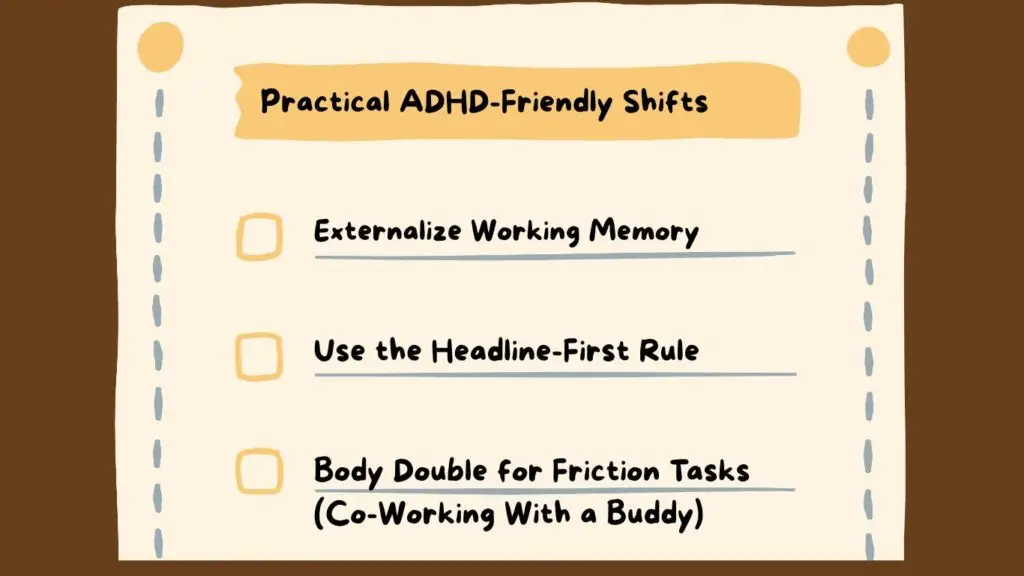
- Externalise Our Working Memory: Stop trying to hold thoughts in our head during conversations. Keep a dedicated pocket notebook or a quick-capture notes app open during meetings. Jotting down a 3-word bullet point satisfies our brain’s urgency so we can listen without interrupting.
- Use the “Headline First” Rule: When explaining a complex idea, force ourself to state the bottom-line conclusion in one sentence before giving the backstory. This anchors both us and our listener.
- Work Alongside a “Focus Buddy”: If replying to emails or starting a report feels overwhelming, work alongside someone else, either in person at a quiet café or via a silent video call. Having a calm, shared presence helps settle the nervous system and makes it much easier to get started.
Frequently Asked Questions About ADHD Coaching & Speech Therapy in Singapore
1. Do I need a formal medical diagnosis of ADHD to book coaching or speech therapy?
No, you do not need a formal diagnosis to work with us. Many adults and students in Singapore suspect they have ADHD or struggle with executive dysfunction without having gone through a formal psychiatric assessment. We focus on your lived experiences, daily challenges, and personal goals, meeting you exactly where you are without requiring a label first.
2. What is the difference between ADHD Coaching, Speech Therapy, and Counselling?
While all three are supportive, they serve distinct purposes:
- Speech & Language Therapy builds foundational communication, auditory processing, and thought-organization skills.
- ICF ADHD Coaching is forward-looking and action-oriented, helping you build brain-friendly routines, dopamine-friendly workflows, and intentional follow-through to bridge the gap between knowing what to do and actually doing it.
- Counselling & Psychotherapy helps you process deeper emotional wounds, anxiety, burnout, or trauma using evidence-based approaches like CBT, ACT, and DBT.
Because our team offers all three under one roof, we can tailor a holistic support plan around your unique needs.
3. Is this service only for children, or do you work with working adults too?
We work with individuals across the lifespan, including children, teens, university students, and working adults. Many of our adult clients come to us after navigating years of workplace masking, career transitions, or communication burnout, looking for sustainable, neurodiversity-affirming strategies that actually fit their busy lives.
4. Can sessions be done online, or do I have to visit your clinic in Tanjong Pagar?
We offer flexible options to suit your schedule and comfort level. You can visit us in person at our welcoming, quiet space at 171 Tras Street (Union Building), just minutes from Tanjong Pagar MRT, or opt for secure online tele-therapy and coaching sessions from the comfort of your home or office.
Ready to Work With Your Brain? Let’s Talk.
Living with ADHD in a fast-paced environment like Singapore can feel isolating, especially when you feel misunderstood by colleagues, teachers, or loved ones. You don’t have to figure it all out alone.
At Joyful Soul Psychology (conveniently located near Tanjong Pagar at 171 Tras Street), we offer a warm, accepting space where you are seen, heard, and celebrated, flaws and all. Whether you are seeking specialised Speech & Language Therapy, ICF ADHD Coaching, or a tailored blend of both for yourself or your child, we are here to walk alongside you.
Take the first step without pressure.
Book a free 15-minute phone consultation with us today. We’ll chat about what you’re currently navigating, answer your questions, and explore how we can support your journey toward clarity and confidence.
What’sApp +65 8835 3015 / Email contact@joyfulsoulpsychology.com / IG https://www.instagram.com/joyfulsoulpsychology/ / JSP Supports https://joyfulsoulpsychology.com/services/

